
Ford P0430 Catalyst Bank 2: Hello gear heads and automotive enthusiasts! Nothing ruins your car’s faster mood when you are having fundraising on the road from looking at the lightsCheck Engine suddenly lights up brightly in the dashboard.
Your heart might be racing a little, and your mind immediately flashes to expensive repair shop bills. When you reach for an OBD-II (OBD2) scanner,scanner) from the dashboard drawer and plugged it in, the screen showed the dreaded code:P0430.
For many Ford owners, from the rugged F-150 to the powerful Mustang, this code often triggers panic. Many repair shops will immediately tell you to expect thousands of dollars in replacement costs.catalytic converter(catalyst).
But wait! Don’t just fire the “cannon” right away!”spare part” (parts cannon) to your car. In this comprehensive article, we’ll get under the hood, open the hood, and thoroughly dissect the underlying problem behind this P0430 code.
We’ll go over it in true mechanic style: logical, detailed, and solution-oriented so you don’t waste your hard-earned money.
Ford P0430 Catalyst Bank 2 Overview
In general, when the car’s computer system (PCM orPowertrain Control Module) displays a P0430 code, the vehicle is telling you that there is a problem with the efficiency of the emissions system on one side of the engine.

Catalytic conversion is a crucial component that functions like your immune system or a mini chemical factory for your exhaust, responsible for converting toxic combustion gases into safe emissions.
However, this code doesn’t always mean your catalyst is dead or damaged. The problem could be as simple as an exhaust leak, or a sensor that has started to fail.lazy(lazy/slow to read), or fuel mixture problems.
In this guide, we’ll break down each layer of diagnostics so you know exactly what to check before deciding on a repair.
What Is Ford P0430?
What exactly is Ford P0430? In engine language, Ford P0430 is a diagnostic code that meansPowertrain Control ModuleYour car’s (PCM) has detected that the catalytic converter, which is on the side of “Bank 2” , its performance is below the permitted efficiency standard.
Modern Ford vehicles are designed to meet very stringent emissions standards. The PCM constantly evaluates the catalyst’s ability to store and release oxygen. When the oxygen storage capacity within the catalyst falls below a threshold (threshold) programmed by the Ford factory, the computer will register this anomaly. It should be noted, Ford will not immediately turn on the lightCheck Engine at the first failure.
Two driving cycles are required (drive cycles) that successively fail before that warning light finally comes on on your instrument panel.
Ford P0430 Catalyst Bank 2 Meaning
Let’s translate the technical meaning. The official abbreviation for P0430 is Catalyst System Efficiency Below Threshold (Bank 2).
This diagnostic code is generic for all OBD-II vehicles, but its meaning is always the same: the PCM detects that the catalyst system is no longer able to clean exhaust gases efficiently. The engine is producing harmful pollutants such as Carbon Monoxide (CO), Hydrocarbons (HC), and Nitrogen Oxides (NOx).
The catalyst uses precious metals such as platinum, palladium, and rhodium to trigger chemical reactions (oxidation and reduction) that convert the toxins into carbon dioxide (CO2), water (H2O), and nitrogen. If this chemical process fails to occur efficiently on the Bank 2 side, the P0430 code is generated.
Ford P0430 Catalyst Bank 2 Symptoms
What is it like to drive with this code? Often, if the catalyst is not badly clogged, you may/will not feel any symptoms of decreased performance at all. Cars may still drive normally on toll roads.
However, over time, some typical symptoms may appear, including:
- Check Engine Light Comes On:This is the most definite symptom.
- Failed Smog Test:If you live in an area with strict emissions standards, your car will definitely fail inspection.
- Sulfur/Rotten Egg Smell:This happens when unburned fuel builds up and triggers a pungent odor from the exhaust tip.
- Fuel Efficiency Decrease (MPG):The car may feel more fuel-hungry because the PCM may be trying to adjust the fuel mixture.
- Weak Acceleration and Rough Engine (Rough Idle):Especially when the engine is cold. If the converter melts internally and blocks the exhaust flow, the car will feel like it’s holding back when you press the accelerator.
Ford P0430 Catalyst Bank 2 Causes
A catalytic converter rarely dies on its own; there is usually an upstream component (upstream) that “killed it”. Here are the main causes of P0430:
- Damaged/Worn Catalyst:It often occurs in high mileage cars (over 150,000 miles) where the precious metal coating has worn away.
- Misfire in Ignition System:A dead spark plug or coil (COP) will dump raw fuel directly into the exhaust. This fuel burns inside the catalyst at extreme temperatures, melting the honeycomb structure (honeycomb) inside it.
- Exhaust Leak:Leakage onmanifoldA leak in the exhaust or gasket will allow fresh oxygen from outside into the exhaust stream. The sensor reads this as catalyst damage, even though it’s just outside air coming in.
- Oxygen (O2) Sensor Failure:Downstream O2 sensor (downstream) that is slow or damaged can provide false data to the PCM.
- Oil or Coolant Contamination:Worn piston rings allow oil to burn, coating the catalyst with phosphorus. Cylinder head gasket leaks (head gasket) can coat the catalyst with silicates from the coolant. Both are permanent damage.
- Sulfur Contamination:This often occurs in Ford EcoBoost engines that use high-sulfur fuel.
Ford P0430 Catalyst Bank 2 Diagnose
To diagnose P0430 like a professional mechanic in America, you need to be methodical. Don’t immediately point to the catalyst as the culprit.
- Scan Another Code:If there is a codemisfire(P0300) or fuel mixture (P0171/P0174), correct those codes first.
- Visual and Auditory Inspection:Start the engine when it is cold and listen for a ticking sound (ticking) from the exhaust area indicating a leak manifold. The slightest leak will trigger this code.
- Check Catalyst Temperature:Use an infrared/laser thermometer. Measure the temperature of the pipes in front of the catalyst and behind it while the engine is hot. Normally, the temperature(back) should be hotter than inlet(front). If the temperature is the same, your catalyst is not working.
- Use Live Data / Mode $06:ConnectscannerUse Mode $06 (Monitor ID $22 for Ford) to view live PCM test values.
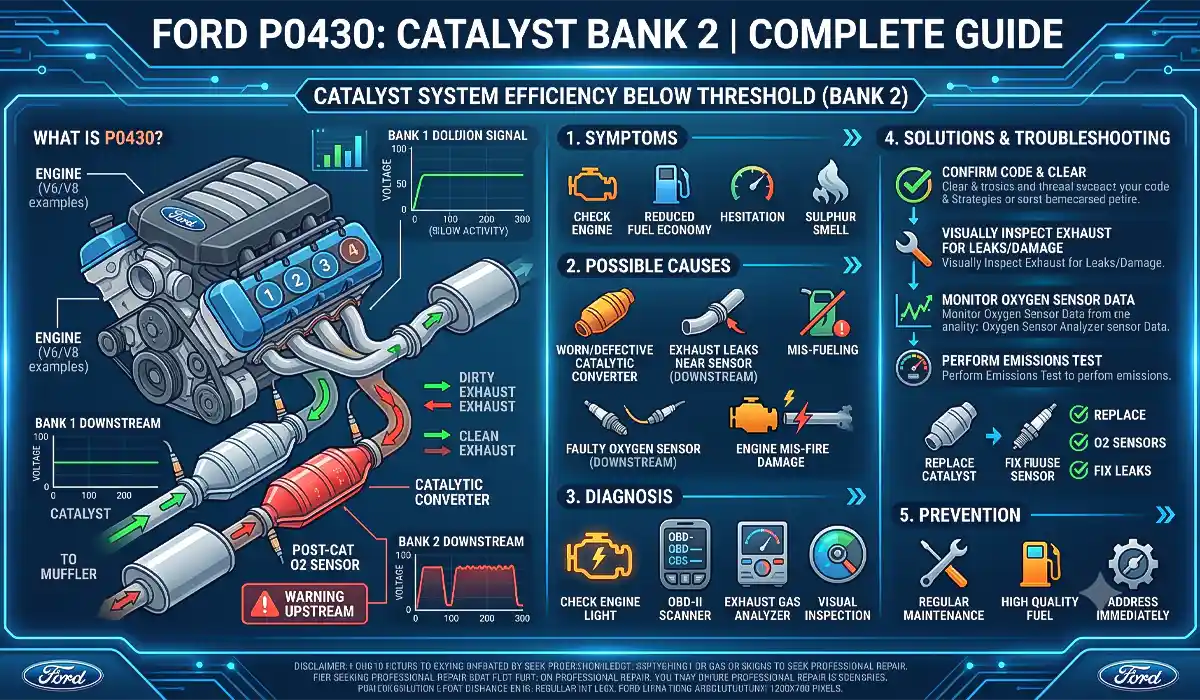
Ford P0430 Catalyst Bank 2 Sensor 1
Let’s discuss the sensing components.Sensor 1is the upstream sensor (upstream oxygen sensor). This sensor is located in the exhaust manifold, just before the exhaust gas enters the catalytic converter.
The main job of Sensor 1 is to detect the remaining oxygen from combustion that has just left the engine, and tell the computer whether the fuel mixture is too rich (rich) or too poor (lean).
On the live scanner graphic screen (live data), a healthy Sensor 1 waveform will be seen swinging rapidly up and down between 0.1 Volts and 0.9 Volts. This sensor serves as the basic reference for the system.
Ford P0430 Catalyst Bank 2 Sensor 2
Well, here is the pioneer,Sensor 2 (downstream oxygen sensor). The position is right aftercatalytic converterIf Sensor 1 is the engine’s controller, then Sensor 2 is the catalyst’s quality monitor. When exhaust gases pass through a healthy catalyst, toxic components are neutralized and oxygen levels stabilize.
Therefore, the voltage graph of Sensor 2 on the screenscannerIt should be a relatively flat and stable line, usually around 0.45 Volts to 0.7 Volts. If Sensor 2 suddenly starts jumping around mimicking Sensor 1’s wild graph, the computer will know right away that the catalyst is no longer filtering or “holding” the oxygen, and boom, PCM prints code P0430.
Ford P0430 Catalyst Bank 2 Location
The most fatal mistake amateur mechanics make is dismantling the wrong side of the engine. So, where exactly is it?Bank on your Ford car?
Ford defines Bank 2 based on engine configuration:
- Longitudinal Type V Engine (Extending backwards):Like on an F-150, Mustang, or Expedition truck. Bank 1 is the passenger side (cylinder number 1 side). So,Bank 2 is the driver’s side(left side when viewed from the driver’s seat).
- Transverse V Type Engine:As in the Ford Explorer, Edge, or Flex. Bank 1 is usually located near the firewall (firewall).
- Therefore,Bank 2 is the side facing the radiator(front of vehicle).
- Make sure you check the right side before turning those stubborn, rusty exhaust bolts!
P0430 Catalyst System Bank 2
UnderstandCatalyst System Bank 2Overall, this is very important. This system isn’t just about a single catalyst tube. It’s an ecosystem that involves the driver-side exhaust pipe, Sensor 1, the catalytic converter, and Sensor 2.
The entire flow from the exhaust port of the Bank 2 cylinder to the exhaust must be airtight for the PCM to accurately monitor the chemistry. If even a small amount of fresh air is allowed to seep in through a weld or a broken gasket, Sensor 2 will read the outside air as “poor efficiency,” and throw a P0430 code.
P0430 Catalyst System Low Efficiency Bank 2
Term Low Efficiency(Low Efficiency) literally refers to the catalyst’s inability to retain and process emissions. Inside the converter, there is a honeycomb-shaped ceramic material coated with rare earth metals.
When these metals lose their ability to bind to pollutant particles, either due to age (after 150,000 miles) or sulfur and phosphorus poisoning (from burning oil), their chemical conversion efficiency drops dramatically. Harmful gases simply pass through unprocessed. This is what the OBD-II system registers as a “Low Efficiency” condition.
P0430 Catalyst System Efficiency Below Bank 2
Continuing the previous point, keywords”Below Threshold”(Below Threshold) means the PCM does not expect 100% perfection from your emissions system for the lifetime of the vehicle. Over time, the catalyst will degrade slightly. Ford engineers have programmed a minimum tolerance limit (threshold) inside software PCM.
For example, perhaps the factory threshold is 70% efficiency. As long as the catalyst is operating at 71% efficiency, the light willCheck Enginewill not turn on. However, when its performance drops to 69% over two driving cycles, the sensor will trigger a warning that its efficiency has reached below the threshold.
Ford P0430 Code Bank 2
Ford has a specialty in handlingP0430 Code Bank 2. Ford’s PCM calibration software system (commonly called OBD-II strategy) is extremely precise. Ford’s computers don’t just look at emissions; they measure oxygen storage capacity microscopically. Because of this sensitivity, the catalystaftermarketCheap ones often fail to turn off the P0430 light on Ford cars.
Catalyst after market usually have a lower precious metal content. Although they may be clean enough to pass an emissions test from the rear exhaust (tailpipe), Ford’s intelligent PCM still knows that its “storage capacity” is low, and the code will reappear in 500-1,000 miles.
This is why Ford experts always recommend replacing it with spare parts.Original Equipment Manufacturer(OEM) if possible.
P0430 Ford F150 Bank 2
Let’s focus on America’s favorite truck,Ford F-150This truck is a “regular” P0430 code. On the legendary F-150 5.4L Triton V8 (3-valve models from 2004-2008), the number one cause is often NOT a dead catalyst, but rather a leak.exhaust manifold on the passenger/driver side due to a broken stud bolt.
This leak fools the sensors. On the other hand, for the EcoBoost-powered F-150 trucks (2018-2021), Ford released a documentTechnical Service Bulletin(TSB 22-2260). In this engine variant, the problem is often caused by sulfur contamination from the fuel adhering to the precious metals in the Bank 2 catalyst. The solution may not even require replacement of the part!
P0430 Code Bank 2 Location Ford
Repeating and emphasizing the physical location ofP0430 Code Bank 2 LocationIt’s vital when you’re holding a wrench. Remember Ford’s rule: Bank 1 is always the group of cylinders that Cylinder Number 1 is in.
- V8 Coyote (F-150/Mustang): Cylinder 1 is on the right front (passenger) side. Bank 2 is on the left (driver) side.
- V6 EcoBoost (F-150): Cylinder 1 on the passenger side. Bank 2 on the driver’s side.
- V6 Cyclone (Explorer FWD/AWD bias): Bank 1 is at the rear near the cabin. Bank 2 is at the front near the radiator. Diagnosing the wrong bank will waste time, money, and your sanity.
P0430 Code Bank 2 Location Ford F150
Specifically forFord F-150, the layout is standard. Because the F-150 uses a rear-wheel drive (RWD) engine with a longitudinally extended position, the sideBank 2 will always refer to the driver’s side (Driver’s Side)from the engine and transmission. The catalyst tube is located underfloorboard(floor) left side.
Oxygen Sensor 1 is located just before this catalyst tube, and Oxygen Sensor 2 is attached slightly behind or attached to the body of the tube.
P0430 Catalyst System Below Threshold Bank 2
Discussion aboutBelow Threshold reminds us of the permanent memory code (Permanent DTCs/ PDTCs). On Fords manufactured after 2010, if the system falls below threshold and P0430 is recorded as a PDTC, you cannot simply reset the code by disconnecting the battery or pressing the “Clear” button on the scanner.
To clear PDTC on a Ford, the computer requires you to actually fix the physical problem, then perform a certain driving cycle (drive cycle) until the PCM system performs its own emissions check and is satisfied that the system is now operating “Above Threshold.” This is the modern federal OBD-II regulation.
P0430 Code Bank 2
In short,P0430 Code Bank is a comprehensive warning alarm for half of your exhaust system. This code acts as a last-ditch effort before pollution is released into the air.
Often, if ignored for a long period of time, the damaged catalyst in Bank 2 can disintegrate internally, and the fragments can become lodged in the exhaust system, causing heat backflow (backpressure) extreme conditions that can paralyze the car engine or cause overheating(engine is too hot).
While it’s not an emergency the first day the lights come on, don’t ignore this code for months.
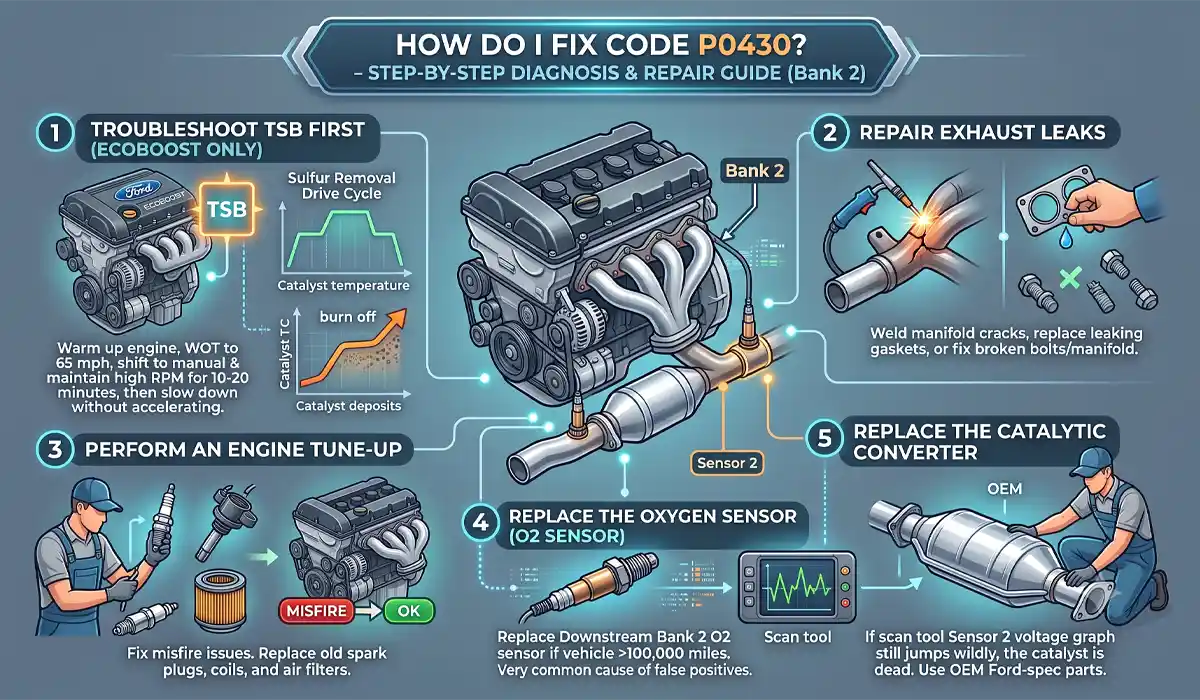
How Do I Fix Code P0430
Now, the practical part:How to fix this code?
- Troubleshoot TSB First (EcoBoost Only):If you have a Ford EcoBoost engine, Ford hasSulfur Removal Drive CycleSpecial. Here’s how: Warm up the engine, accelerate at full throttle (WOT) to 65 mph, then shift into manual gear and maintain a relatively high rpm for several tens of minutes, followed by a slowdown without accelerating. This process raises the catalyst temperature to the point where it “burns” off the sulfur deposits without replacing any parts!
- Repair Exhaust Leaks:Weld the crack in the exhaust, replace the gasket (gasket) that leaks, or repair the bolts/manifold broken. Exhaust leaks are the cheapest cause of repairs.
- Perform an Engine Tune-Up:Fix the problem/misfire. Replace old spark plugs, coils, and air filters.
- Replace the Oxygen Sensor (O2 Sensor):Try replacing the O2 sensorDownstreamBank 2 if the car is over 100,000 miles old. This sensor is relatively inexpensive (around $20-$80) and is very often the culprit for false reports (false positives).
- Replace the Catalytic Converter:If you have tested withscannerIf the Sensor 2 voltage graph is still jumping wildly, your catalyst is officially dead. Purchase an OEM Ford-spec catalyst. They’re expensive (can be $1,200-$2,500), but they’ll solve the problem without the code returning next month.
What Causes Code P0430
Summarizing the technical points above, always ask,”What killed this converter?”before you install a new one. The main causes include:
- Misfire due to worn coil or spark plug (melted catalyst).
- Leaking fuel injector that is leaking raw gasoline (Overheating).
- The piston rings wear out so the oil is burned (Phosphorus Poisoning).
- Leakhead gasket(Coolant Silicate Poisoning).
- High sulfur fuel (Sulfur Poisoning – reversible). If you replace the catalyst tube without fixing the dead spark plug, your new catalyst, which cost thousands of dollars, will be destroyed again in a matter of weeks!
Ford P0430 Catalyst Bank 2 Prevention
How can you, as a concerned Ford owner, prevent the code?P0430This drains your wallet? The best prevention is regular, scheduled maintenance.
- Replace Spark Plugs on Time:Don’t let your spark plugs wear out. Healthy spark plugs mean perfect combustion without wasting raw
- gasoline into the exhaust.
Use Quality Oil and Fuel:Use high-quality engine oil with minimal evaporation and gasoline with a good octane/detergent rating (such as an occasional premium fuel fill-up to clean the injectors). - Don’t Ignore the LightsCheck Engine:If the light is on because misfire(e.g. P0300), fix it immediately! Don’t delay for weeks.
- Use Additives:Regular fuel injector cleaning also helps maintain a good fuel spray pattern and reduces the load on the catalytic converter.
Verdict
The Ford P0430 code doesn’t automatically mean you need a new catalytic converter. In many cases, the real culprit is a misfire, an exhaust leak, a failing O2 sensor, or another engine issue that should be fixed first. A careful diagnosis can save you hundreds—or even thousands—of dollars while restoring your Ford’s performance and emissions system.
As Final Decision (Verdict), OBD-II code Ford P0430It’s not an immediate death sentence for your car or your wallet. While seeing the Check Engine light on is always frustrating, you now have the information to handle it like a professional mechanic.
Start with the basics: make sure there are no exhaust leaks, check that the engine is running perfectly (nomisfire), then consider testing the downstream O2 sensor on Bank 2 (driver’s side for trucks, or near the radiator on cross-country vehicles).
If you have an EcoBoost engine, try the “sulfur burn” maneuver on the highway for free first. Only if all cheap options have failed, and the datascannerconfirming the catalyst is dead, then be prepared to purchase a quality OEM catalyst unit.
We’ll continue updating this guide as new Ford technical bulletins, repair procedures, and real-world solutions become available. If you found this article helpful, explore more of our Ford troubleshooting guides and expert automotive content. Bookmark this website today and come back anytime for the latest updates, trusted repair advice, and practical tips that keep your Ford running at its best.
Smart, patient, and focused diagnostics will ensure your Ford roars back onto the road clean and powerful!Keep rolling and wrenching safely!


