
Ford P0022 Camshaft Timing Bank 2: The sudden illumination of the Check Engine Light on your vehicle’s dashboard is a moment that often causes panic among car owners. When an OBD-II scanner is connected to the diagnostic port under the dashboard, one of the automotive error codes that is quite often found in modern American engines such as the Ford F-150, Explorer, Mustang, and Expedition appears, namely the P0022 code.
For the general public or novice car owners, seeing terms like “Intake Camshaft Position Timing Over-Retarded Bank 2” may sound very complicated and scary. However, in the world of American automotive repair, this code is a very specific diagnostic clue regarding how your engine’s hydraulic and mechanical systems are working.
In this comprehensive article, we will explore everything about OBD-II trouble codes, from the basic principles of engine operation, sensor locations, driver-facing symptoms, root causes such as dirty oil or a stuck VCT solenoid, to technical diagnostic steps and preventative measures.
Ford P0022 Camshaft Timing Bank 2 Overview
The Variable Valve Timing (VVT) system, or Variable Camshaft Timing (VCT) in Ford engines, is one of the marvels of modern engine engineering. In earlier engines before the invention of camshaft position sensors, ignition and engine timing were conventionally controlled using a mechanical distributor where clockwise rotation retarded timing and counterclockwise rotation advanced timing.
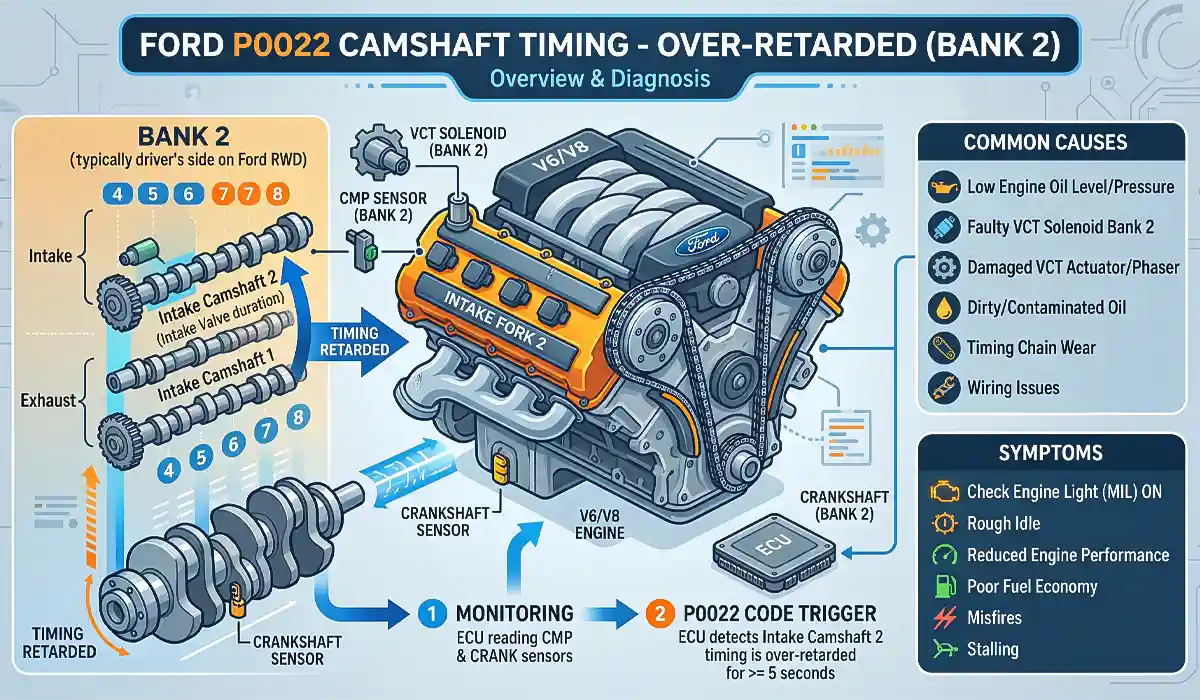
In modern high-performance engines like Ford’s V6 3.5L EcoBoost or V8 5.0L Ti-VCT Coyote, the vehicle’s main computer, called the Powertrain Control Module (PCM) or Engine Control Module (ECM), actively adjusts the opening and closing times of the intake and exhaust valves based on engine speed, vehicle load, temperature, and accelerator pedal position.
The P0022 diagnostic code falls under the SAE generic Powertrain code category and indicates a timing performance issue on the Intake Camshaft in Bank 2. “Over-Retarded” simply means the camshaft is in a late (retarded) position beyond the angle limit commanded by the PCM, or fails to advance again when needed.
This triggers decreased engine performance, worsened fuel efficiency, and the emergence of rough noises in the timing chain system.
What Is Ford P0456?
In the world of Ford vehicle diagnostics, OBD-II codes are divided into various categories of internal vehicle systems. While discussing engine timing issues like the P0022 code, vehicle owners sometimes encounter other codes like Ford P0456 in their scanner scan reports.
P0456 is a standard OBD-II trouble code that refers to Evaporative Emission Control System (EVAP) Very Small Leak Detected, or a very small leak found in the vehicle’s fuel evaporative emission control system.
The EVAP system is responsible for trapping gasoline vapors from the fuel tank to prevent them from escaping directly into the atmosphere and channeling them back into the engine’s combustion chamber to be burned.
When the PCM detects a drop in pressure or a small leak in this vapor tank and line system (such as a loose gas cap or a cracked EVAP hose), the vehicle’s computer will register a P0456 code.
Meaning Of P0456
Understanding the meaning of Ford’s P0456 code is crucial for distinguishing between environmental evaporative emissions issues and internal engine mechanical problems. The technical meaning of P0456 is the presence of a very small leak in the EVAP system (usually less than 0.020 inches in diameter).
This code has no direct bearing on the internal operation of the combustion chamber, the firing order, or the engine oil pressure that controls the camshaft system.
Even if a P0456 code turns on the Check Engine light on the dashboard and causes your car to fail an emissions test, the vehicle can generally still be driven normally mechanically without risking damage to internal engine components.
This is in contrast to a timing code like P0022, which indicates a mechanical or hydraulic problem directly with the camshaft, potentially damaging the engine if left untreated.
Ford P0022 Camshaft Timing Bank 2 Symptoms
When the P0022 code is active in your vehicle’s engine computer, there are a variety of noticeable symptoms that can be felt by the driver or heard directly from the engine compartment. These symptoms can range from mild to severely disruptive to driving comfort:
- Check Engine Light (MIL) Illuminates: This is the first and most obvious sign when the PCM detects a camshaft angle variation that deviates from the manufacturer’s parameters.
- Rough Idle: The engine feels like it is vibrating violently or the RPM fluctuates unstably when the vehicle is stopped at a red light or when the engine temperature starts to warm up.
- Loss of Power and Slow Acceleration (Hesitation & Loss of Power): When you press the gas pedal to climb or overtake on the highway, the engine feels weak, responds very slowly (lag), or loses low-end torque drastically.
- Hard Starting / Extended Cranking: The starter takes longer than usual to crank before the engine finally starts.
- Engine Stalling: In severe cases, the engine can stall on its own when the vehicle is idling or when stopping slowly.
- Poor Fuel Economy: Intake valves that open and close at inappropriate times cause the air-fuel mixture to be filled in the cylinder inefficiently, impairing fuel efficiency.
- Startup Rattle Noise: A metallic banging or rattling noise is heard from the front of the engine for a few seconds when first starting it in the morning due to loss of hydraulic oil pressure in the phaser or tensioner.
- Emergency Mode Lockout (Limp Mode): The Ford PCM will lock the phaser movement to the default position (e.g., at a 49-degree angle) to protect the engine’s internal components from mechanical impact, electronically limiting engine power.
Ford P0022 Camshaft Timing Bank 2 Causes
The causes of the P0022 error code can be classified into hydraulic oil problems, mechanical timing components, sensor electrical problems, and control software. The following are the main causes most frequently encountered in the field:
- Dirty or Sludge Engine Oil: Engine oil that is rarely changed contains carbon deposits and contaminants that clog the micro oil channels leading to the VCT solenoid and cam phaser.
- Incorrect Engine Oil Viscosity: Using oil that is too thick (e.g. 10W-40 on an engine that requires 5W-20) slows the flow of hydraulic oil when the engine is cold, while oil that is too thin causes loss of hydraulic pressure when the engine is hot.
- Low Engine Oil Level and Pressure: A worn oil pump, clogged oil pickup screen, or insufficient oil volume prevents the VCT system from getting enough hydraulic pressure to rotate the phaser.
- VCT / Oil Control Valve (OCV) Solenoid Stuck or Blocked: The oil flow control solenoid on Bank 2 has experienced mechanical jamming due to dirt or damage to the electrical coil.
- Camshaft Phaser (VVT Actuator) Damage: The camshaft phaser component experiences internal wear, internal oil pressure bleeding, or the locking pin is broken or loose.
- Loose or Stretched Timing Chain: A worn timing chain throws off the synchronization position between the crankshaft and camshaft.
- Broken Timing Chain Tensioner or Guide: The hydraulic tensioner loses pressure or the chain guide rail breaks, causing the timing chain to jump (jumped timing).
- Camshaft Position Sensor (CMP) or Wiring Defect: The camshaft angle measuring sensor is giving an inaccurate signal, or there is a short circuit or break in the wiring in the electrical socket.
Ford P0022 Camshaft Timing Bank 2 Diagnose
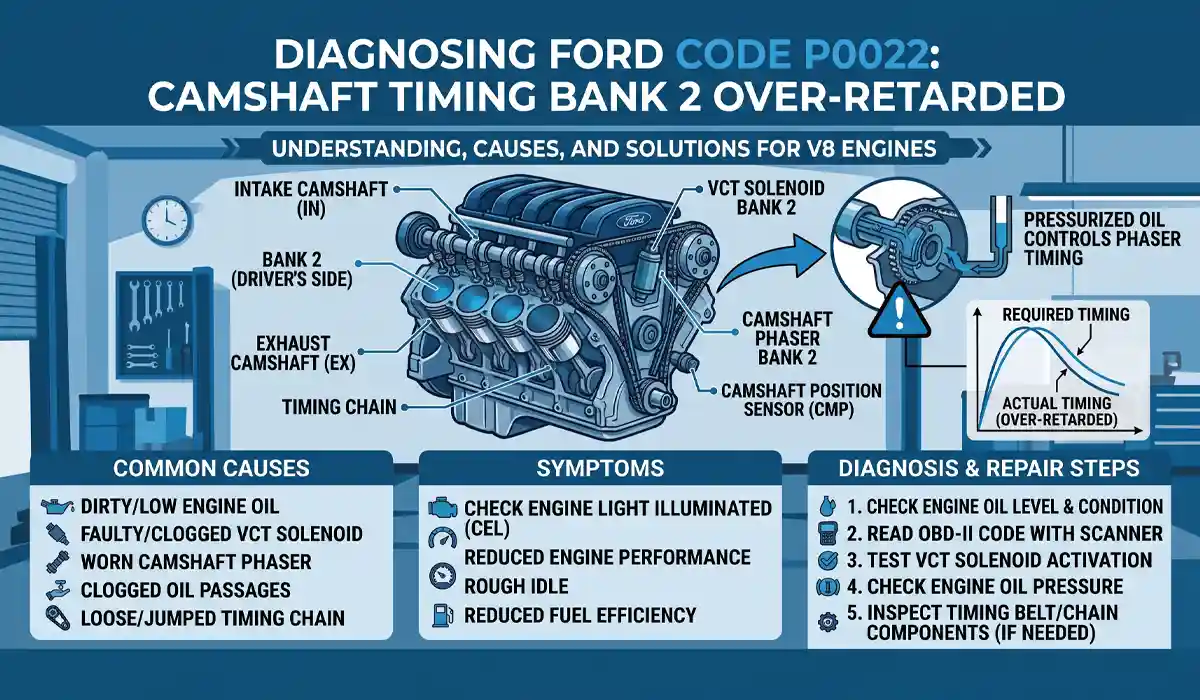
Diagnosing the P0022 code requires a systematic approach from a professional technician to avoid replacing expensive parts without addressing the root cause. Here are the industry-standard diagnostic steps:
- OBD-II Code Scan & Save Freeze Frame Data: Connect an advanced OBD-II scanner to record all active and pending trouble codes, as well as engine parameter data when the P0022 code is triggered.
- Check the engine oil level and condition: Remove the oil dipstick. Make sure the oil level is at the upper limit line, does not smell of gasoline, and is free of excess black sludge or metal debris.
- Mechanical Oil Pressure Test: Install a mechanical oil pressure gauge into the engine block test port. Verify that the engine oil pressure is within the manufacturer’s specifications (e.g., a minimum of 15–25 PSI with the engine warm and idling).
- Physical Inspection of Wiring and VCT Solenoid Socket / CMP Sensor: Inspect the Bank 2 wiring socket electrically for corrosion, bent pins, peeled cable insulation, or oil seepage into the socket.
- Camshaft Position Live Data Stream Monitoring: Use the scan tool’s live data function to compare the Commanded Camshaft Angle (PCM-requested angle) with the Actual Camshaft Angle (actual angle) on Bank 2. A deviation of more than 5 degrees indicates an over-retarded condition.
- VCT Solenoid Inspection and Cleaning: Remove the Bank 2 VCT solenoid, inspect the screen filter for sludge blockage, and test the mechanical actuation of the solenoid using a 12V battery or the bi-directional actuation function of the scanner.
- Solenoid Swap Test: Swap the VCT Bank 2 solenoid with the VCT Bank 1 solenoid. Clear the code and then perform a road test. If the fault code moves to Bank 1 (becoming a P0012 code), then the solenoid is confirmed to be faulty.
- Mechanical Inspection of Timing Chain and Cam Phaser: If the oil and electrical systems are normal, remove the crankcase or timing cover to check the alignment of the timing marks, cam phaser wear, and timing chain length.
Ford P0022 Camshaft Timing Bank 2 Sensor Location
Understanding the sensor locations on a Ford engine is crucial to avoid accidentally dismantling components on the wrong side. The Ford P0022 Camshaft Timing Bank 2 Sensor is located on the cylinder head in Bank 2 of the engine.
In American automotive engine terminology, Bank 2 is defined as the side of the engine block that does not contain cylinder #1. On Ford engines with a longitudinal configuration (such as the F-150 truck, Expedition SUV, or rear-wheel-drive Mustang), Bank 1 is on the right side of the vehicle / passenger side, so Bank 2 is on the left side of the vehicle / driver side.
The Bank 2 camshaft position sensor is usually mounted on the front or rear top of the valve cover on the driver’s side.
Ford P0022 Camshaft Timing Bank 2 Sensor 2
On modern Ford DOHC (Dual Overhead Camshaft) engines with four camshafts (two intake and two exhaust), there are several camshaft position sensors that send data to the PCM. The term Sensor 2 or Camshaft Sensor B generally refers to the sensor that monitors the exhaust camshaft on Bank 2.
Although the primary code P0022 specifically focuses on the intake camshaft (Intake/Sensor 1), the PCM continuously compares readings from Sensor 2 (Exhaust) and Sensor 1 (Intake) in Bank 2 to confirm that the correlation is within safe operating tolerances.
If Sensor 2 reads an angle variation due to a stretched primary timing chain issue, the PCM may register a complementary code such as P0025.
Ford P0022 Camshaft Timing Bank 2 Sensor 1
The Ford P0022 Camshaft Timing Bank 2 Sensor 1 designation refers specifically to the intake camshaft position sensor (Intake Camshaft Position Sensor A) on Bank 2. Sensor 1 reads the reluctor wheel waveform attached to the intake cam phaser as the shaft rotates.
The frequency and voltage signals from Sensor 1 are what the PCM uses to detect that the Bank 2 intake shaft is in an “Over-Retarded” condition. When Sensor 1 reports that the intake shaft rotation angle is lagging behind the crankshaft angle by more than the commanded degree, the PCM immediately logs a P0022 fault code.
Ford P0022 Camshaft Timing Bank 2 Location
The physical location of Bank 2 on Ford vehicles can vary depending on the engine layout (transverse vs longitudinal) and engine type:
- Longitudinal V6 and V8 engines (Ford F-150, Expedition, Mustang): The engine is mounted longitudinally from front to rear. Cylinder number 1 is always located on the front right side (passenger side). Therefore, Bank 2 is located on the left side (driver’s side).
- Transverse V6 Engine (Ford Explorer, Edge, Flex Front Wheel Drive/AWD): The engine is mounted transversely in the engine compartment. Bank 1 (cylinder #1) is located at the rear of the engine near the windshield (firewall), while Bank 2 is located at the front of the engine near the radiator.
Knowing the exact location of Bank 2 prevents common mistakes in testing or replacing components on Bank 1 that are actually working normally.
Ford P0022 Camshaft Timing Bank 2 Symptoms
When your Ford vehicle experiences a P0022 problem on Bank 2, typical Ford symptoms will begin to appear:
- Heavy Vibration at Hot Idle: The engine runs smoothly when cold, but once the engine oil reaches operating temperature and becomes thinner, the hydraulic oil pressure to the Bank 2 phaser drops, causing heavy vibration in the cabin.
- Clicking / Rattling Sound Heard on Triton 5.4L or Coyote 5.0L Engine: Typical clicking sound from the driver’s side valve cover due to the cam phaser not being locked properly by the locking pin.
- Engine Loss of Gas Pedal Response: When accelerating from a stop, there is a lag that makes the Ford truck or SUV feel very heavy going uphill.
- Limp Mode Indicator Active: Ford’s computer limits VCT rotation to a certain angle (e.g. locked at 49 degrees) so you cannot trigger a VCT actuation test using a scan tool until the code is cleared.
Ford P0022 Camshaft Timing Bank 2 Sensor
New car owners often assume that the P0022 code automatically means their Camshaft Position Sensor Bank 2 is faulty and needs to be replaced. This is one of the most common diagnostic errors in the repair industry.
The camshaft position sensor is essentially just a “messenger” that reports the camshaft’s physical position to the computer. If the cam phaser disc is truly lagging hydraulically or mechanically due to dirty oil or a stuck solenoid, the sensor is performing its duty very accurately by reporting an over-retarded condition.
Replacing the sensor without correcting the oil supply or VCT solenoid problem will never resolve the P0022 code. Testing the sensor’s specific resistance (range 300–800 ohms) or monitoring the signal waveform with an oscilloscope should be performed before deciding to replace the sensor.
Ford P0022 Camshaft Timing Bank 2 Bank 1
Understanding the difference between Bank 1 and Bank 2 is key to diagnostics of V-configured (V6/V8) engines:
- Bank 1: The side of the engine that houses cylinder number 1. Controls the valve timing for cylinders 1, 2, 3 (on a V6) or 1, 2, 3, 4 (on a V8).
- Bank 2: The side of the engine opposite Bank 1 which houses the remaining cylinders (e.g. cylinders 4, 5, 6 on a V6 or 5, 6, 7, 8 on a V8).
Each Bank has its own independent VCT solenoid and camshaft position sensor control. If the problem occurs only in Bank 2 (P0022 code only), the problem is usually localized to the Bank 2 VCT solenoid, Bank 2 oil passages, or Bank 2 cam phaser.
However, if the problem occurs in both banks simultaneously, the source of the problem is almost certainly in the engine’s central oil system.
Ford P0022 Camshaft Timing Bank 2 Misfire Detected
One of the side effects that often accompanies the P0022 code on Ford engines is the appearance of a misfire (incomplete combustion) error code, such as the P0300 (Random Misfire) code or a cylinder-specific code on Bank 2 such as P0305 (Cylinder 5 Misfire Detected).
This occurs because over-retarded intake shaft timing changes the opening time of the intake valve. As a result, the cylinders in Bank 2 do not receive optimal air supply during the compression stroke, causing volumetric efficiency to drop and the combustion chamber to fail to ignite complete combustion.
If you encounter P0022 accompanied by P0305 on a Ford V8 engine, fixing the Bank 2 VCT system will automatically eliminate the misfire problem.
P0011 Intake Camshaft Position Timing Bank 1
In the OBD-II family of VVT/VCT system fault codes, the P0011 code is a close relative of the P0022 code. P0011 has the definition of “Intake Camshaft Position Timing – Over-Advanced (Bank 1)”.
The fundamental difference between P0011 and P0022 lies in two things:
- Bank Location: P0011 occurred at Bank 1, while P0022 occurred at Bank 2.
- Timing Condition: P0011 is in Over-Advanced condition (timing is too advanced ahead of the PCM command), while P0022 is in Over-Retarded condition (timing is too back/too late).
An over-advanced condition is usually caused by the VCT solenoid being stuck in the fully open position so that hydraulic oil continuously pushes the phaser into the forward position.
Ford Fault Code P0022
The Ford Fault Code P0022 is a very well-known error among Ford F-150, Expedition, and Mustang truck owners, especially those equipped with the 3.5L EcoBoost, 5.0L Coyote, or 5.4L 3-Valve Triton V8 engines. In Ford vehicles, the VCT system relies heavily on a steady flow of clean oil at a stable temperature to drive the VCT phaser.
The main characteristic of the Ford Fault Code P0022 is the presence of Ford PCM protection logic. Once the PCM detects a camshaft degree variation in Bank 2 within a specified period, it disables the VCT actuation control and locks out the phaser command.
As a result, the driver will experience a sudden loss of power and engine vibration at slow speeds.

Ford P0012 And P0022 Codes
When you scan a Ford vehicle and find the codes P0012 (Intake Over-Retarded Bank 1) and P0022 (Intake Over-Retarded Bank 2) appearing simultaneously, this is a very valuable diagnostic indication!
When both the suction shafts in Bank 1 and Bank 2 are over-retarded, the cause is almost certainly not a single faulty sensor or solenoid. The most likely underlying cause is:
- The engine is experiencing severe oil starvation or the central hydraulic oil pressure drops below the minimum tolerance.
- Using engine oil with the wrong viscosity or oil that is very dirty/muddy.
- Decreased performance of the main oil pump or wear of engine bearings.
- According to Ford’s official Technical Service Bulletin (TSB) for certain models prior to the manufacturer’s revision, the simultaneous occurrence of codes P0012 and P0022 requires replacement of the VCT solenoid assembly and flushing of the oil system.
P0014 Exhaust Camshaft Position Timing Bank 1
The P0014 code is defined as “Exhaust “B” Camshaft Position Timing – Over-Advanced (Bank 1)”. This code completes the understanding map of the camshaft timing system on a dual cam (DOHC) engine.
The letter “B” in OBD-II descriptions always refers to the exhaust camshaft, while the letter “A” (as in P0022) refers to the intake camshaft. Understanding the differences between A and B, as well as Bank 1 and Bank 2, ensures technicians dismantle the correct solenoid or sensor line when performing repairs.
Ford P0022 Camshaft Timing Bank 2 Prevention
Fixing timing issues caused by P0022 can be costly, ranging from hundreds to thousands of dollars if a complete timing chain and phaser replacement is required. Therefore, taking preventative measures is the best option for every vehicle owner:
- Change Engine Oil and Filter Regularly: Change engine oil according to the manufacturer’s recommended schedule (never delay beyond the mileage limit). Clean oil prevents the formation of sludge and carbon deposits on the VCT solenoid microfilter.
- Use the Manufacturer’s Official Viscosity and Oil Standard: Always use oil with the viscosity listed on the oil cap or in the manual (e.g., 5W-20 or 5W-30). The correct viscosity ensures the phaser’s hydraulic pressure works precisely.
- Use a High-Quality Oil Filter: High-quality OEM or aftermarket oil filters are equipped with an anti-drainback valve that prevents oil from draining from the cylinder head when the engine is off.
- Address Leaks and Rough Noises Immediately on Cold Starts: Never ignore a rattling timing chain noise on cold starts. This noise indicates a worn hydraulic tensioner or phaser and should be checked immediately before damaging other components.
- Use Genuine (OEM) Parts When Repairing: If replacing a VCT solenoid or cam phaser, always use genuine Ford Motorcraft OEM parts to ensure the hydraulic characteristics and solenoid response perfectly match the PCM programming map.
Verdict
Ford diagnostic code P0022 (Intake Camshaft Position Timing Over-Retarded Bank 2) is a wake-up call for vehicle owners that their engine’s Variable Valve Timing system is experiencing serious problems.
Whether the cause is simple, such as dirty or low engine oil, or a more serious mechanical issue like a stretched timing chain and worn cam phasers, prompt action is key to preventing a potentially devastating valve-piston collision.
For beginners, start with the basics: check your oil dipstick, ensure sufficient oil volume, and perform a fresh oil change.
For advanced technicians and DIY enthusiasts, utilize the live data scan tool, perform a mechanical oil pressure test, and perform a VCT solenoid swap test before moving on to disassembling the timing cover. With proper diagnostics, careful handling, and consistent oil maintenance, your Ford engine will be running smoothly, powerfully, and reliably on the road again!
FAQ: People Also Ask Ford P0022 Camshaft Timing Bank 2
Q: What does camshaft position timing over retarded bank 2 mean?
A: Often logged as diagnostic trouble code P0022 (for intake) or P0025 (for exhaust)—means your car's engine computer has detected that the camshaft on one side of the engine is delayed or lagging behind where it is supposed to be relative to the crankshaft
Q: What are the common causes of a P0022 code?
A: A P0022 trouble code means the intake camshaft timing on engine bank 2 is over-retarded, meaning it is delayed and not advancing as commanded by the computer.
Q: How to fix code P0022 Ford F150?
A: To fix diagnostic trouble code (DTC) P0022 ("Intake Camshaft Position - Timing Over-Retarded, Bank 2") on a Ford F-150, you need to address oil pressure, contamination, or worn variable cam timing (VCT) components. Bank 2 is on the driver's side of the engine.


