
Ford P0456 EVAP Very Small Leak: If you’re a beginner who finds the check engine light on your beloved Ford’s dashboard, don’t panic! You’re in the right place. We’ll dissect one of the most confusing trouble codes for car owners: P0456.
As a beginner, the world of automotive mechanics might feel like a foreign language. But don’t worry. This article is specifically designed in the relaxed, straightforward, and highly understandable language of the American automotive community. We’ll explain every detail in detail so you can understand what’s happening to your car like a seasoned mechanic.
Imagine you’re enjoying a pleasant weekend drive in your Ford, the music playing relaxingly, and suddenly beep! A small yellow engine light illuminates on your dashboard. Your heart rate immediately increases, and your thoughts immediately turn to thousands of dollars in repairs. When you plug your OBD-II scanner (a car trouble code reader) into the port under the steering wheel, a mysterious code appears: P0456.
For most beginners, this can feel daunting. Will the engine explode? Is it safe to continue driving? The answer is: it’s safe, at least in the short term. This P0456 code isn’t a sign of engine failure, but rather a friendly message from your car’s computer that the evaporative emissions system (EVAP) has detected a very small fuel vapor leak.
In the US, this code is notoriously one of the most common, yet most often misdiagnosed, by car owners rushing to replace expensive components. In this article, we’ll break down this issue thoroughly so you don’t get fooled by a sloppy mechanic’s diagnosis!
Ford P0456 EVAP Very Small Leak Overview
Before we go further into the details of the P0456 code, let’s first get acquainted with the system responsible for this code: the EVAP (Evaporative Emission Control System).
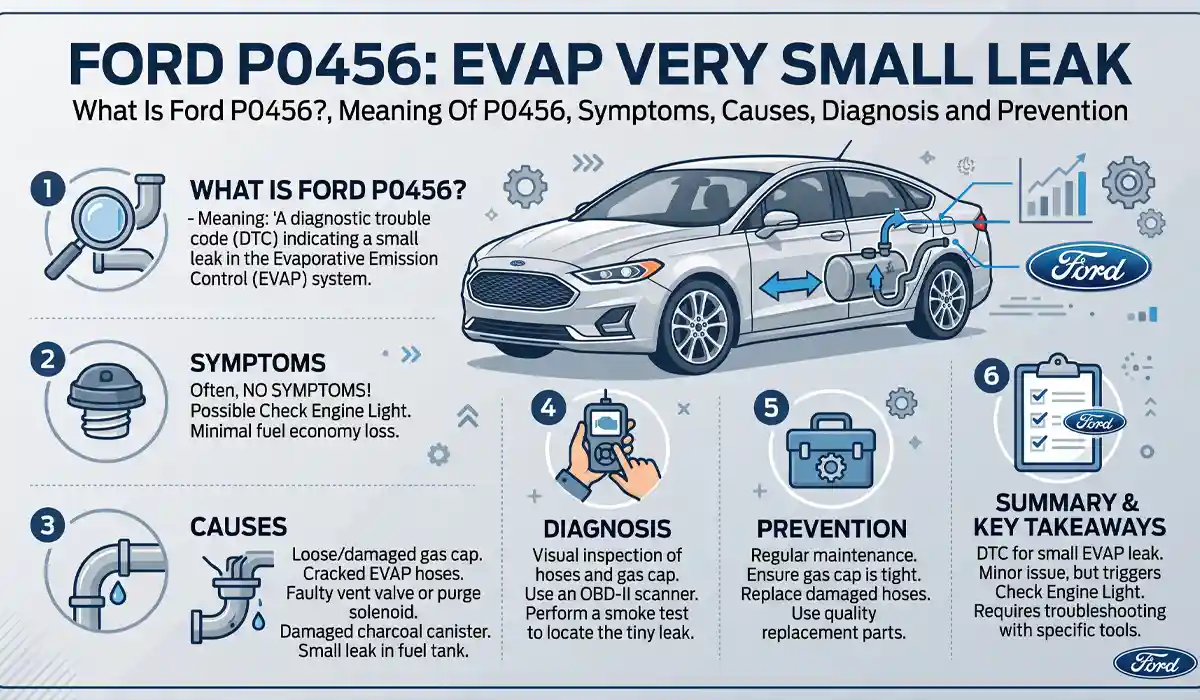
In simple American automotive terms, your car’s gas tank isn’t a sealed container with no circulation. Gasoline is a highly volatile liquid, especially in hot weather. In the past, before strict emissions laws were enacted in the United States, these gasoline vapors were simply vented into the atmosphere through a simple vent. However, gasoline vapors contain harmful hydrocarbons that can degrade air quality and harm the environment.
Thus, the EVAP system was born. This system is a closed circulation network designed to capture, store, and recycle these fuel vapors. Instead of letting gasoline vapors pollute the air, the EVAP system channels them into a special canister containing activated charcoal for temporary storage.
When the engine starts and you start driving, the car’s computer opens a special valve to allow the engine to draw these gasoline vapors into the combustion chamber to be burned with liquid gasoline. Smart, right? Your car saves fuel and protects the planet!
What Is Ford P0456?
Now, what is the specific meaning of Ford code P0456? Technically, P0456 is a generic OBD-II diagnostic trouble code (DTC) that stands for “Evaporative Emission System Leak Detected (Very Small Leak)” or the presence of a very small vapor leak in your Ford’s evaporative emissions system.
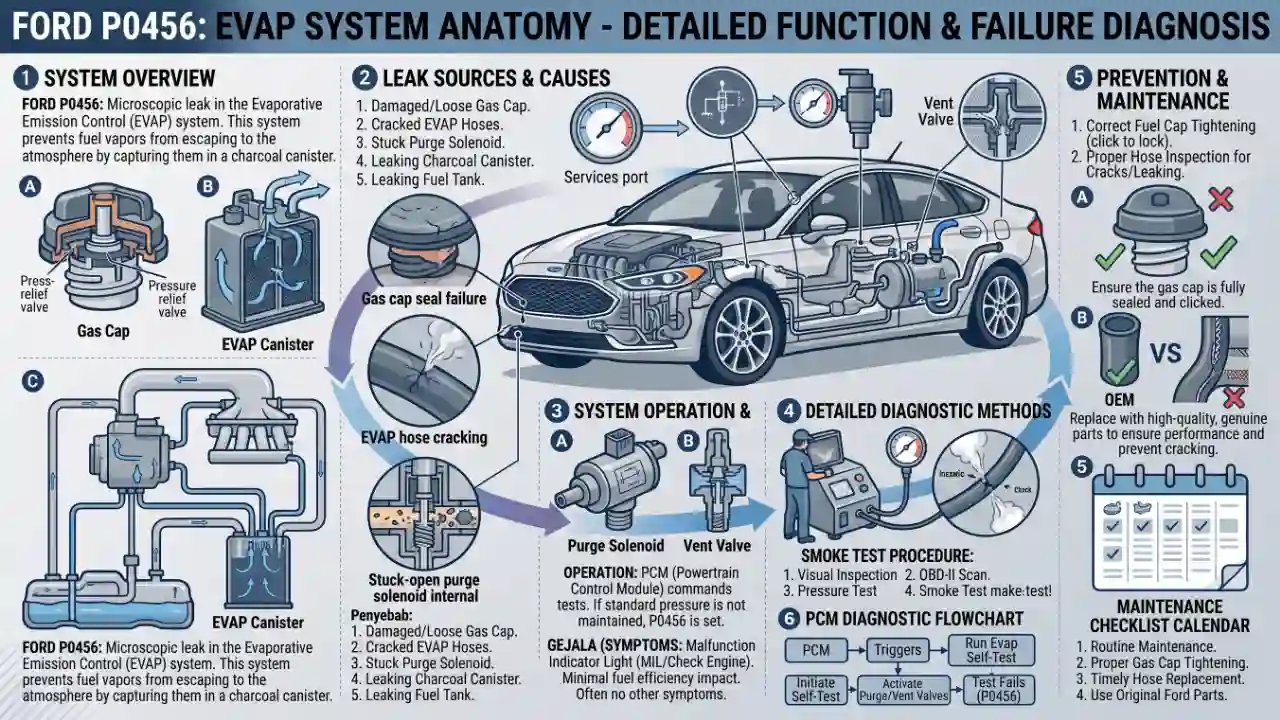
In Ford vehicles, the car’s computer, called the Powertrain Control Module (PCM), continuously monitors the integrity of the EVAP system. While driving or while the car is parked, the PCM performs a series of automatic tests to ensure the EVAP system is properly sealed. If the PCM detects that the system is not maintaining proper vacuum pressuremeaning gasoline vapors are escapingit will illuminate the Check Engine Light and store a P0456 code in its memory.
Meaning Of P0456
To understand this code more deeply, let’s talk about size. How small is this “Very Small Leak” leak? The numbers behind this P0456 code are staggering. The leak detected by your car’s computer is equivalent to a hole just 0.020 inches (about 0.5 millimeters) in diameter! For a scientific comparison that’s easy for beginners to understand, that hole is about the thickness of a business card or a very thin pinhole.
Because these leaks are so small, the escaping vapors are nearly impossible to hear, see, or even smell under normal conditions. Your Ford’s computer uses a highly sensitive fuel tank pressure (FTP) sensor to detect this very slow drop in vacuum pressure. If the pressure drops beyond a tolerance within a specified test period, the computer will determine there is a micro-leak in the system.
Ford P0456 EVAP Very Small Leak Symptoms
One reason the P0456 code is often overlooked is because its symptoms are so minimal. Unlike engine cylinder fault codes, which cause the car to vibrate violently, P0456 generally doesn’t affect your driving comfort.
Here are some symptoms you may experience or find in your Ford:
- Check Engine Light is On: This is the most obvious symptom and often the only one car owners notice. This light will remain amber on your dashboard until the problem is fixed.
- Failed Emissions Test (Smog Test): In many areas, especially if you live in a US state with strict environmental regulations, an active Check Engine light or a stored emissions code will automatically cause your car to fail an emissions test.
- Faint Gasoline Smell at the Rear of the Car: On a hot day, you might notice a very faint gasoline scent near the rear wheels or near the gas cap. However, remember, if the smell is very strong, it could indicate a liquid fuel leak, not just vapor!
- Engine Is Slightly Hard to Start After Filling with Gas: If the leak is caused by a stuck purge valve in the open position, gasoline vapors from the tank will immediately flood the engine manifold when you fill up, causing the engine to stutter slightly or take longer to start.
Ford P0456 EVAP Very Small Leak Causes
While the code may sound simple, locating a pinhole requires incredible patience. Why? Because a leak as small as 0.020 inches can be caused by numerous components along the EVAP line, which runs from the front of the engine to the rear of the car’s fuel tank.
Here are the prime suspects behind the P0456 code:
- Loose or Damaged Gas Cap: This is the number one cause, accounting for about 35% of cases. The O-ring on the gas cap can harden, crack, or become dirty as the car ages, allowing gasoline vapors to escape.
- Cracked or Worn EVAP Hoses: The plastic and rubber hoses that carry gasoline vapors under your car can become brittle from engine heat and weather exposure, creating micro-cracks that are hard to see.
- Leaking Purge Valve: This valve serves as the gateway for gasoline vapor to enter the engine. If this valve doesn’t close properly due to carbon dust buildup, the system will lose vacuum.
- Dirty or Damaged Vent Valve: This valve, usually located near the carbon canister at the rear of the car, shuts off the outside air flow during leak testing. If this valve becomes clogged with road debris or rust, gasoline vapors will leak out.
- Cracked Charcoal Canister: The plastic frame of the canister can crack due to impact with road stones or due to age.
- Loose Fuel Pump Gasket: If you recently replaced your fuel pump, a slightly crooked rubber gasket at the top of the tank can allow gasoline vapors to escape.
Ford P0456 EVAP Very Small Leak Diagnosis
How do American automotive professionals diagnose these microscopic leaks? As a beginner, you need to know the correct diagnostic process to avoid getting caught in costly guesswork.
The following are recommended diagnostic steps:
- Step 1: Simple Visual Inspection (Free!)
Start with the simplest thing. Open your gas cap. Inspect the rubber ring underneath. Does it feel hard, cracked, or covered in thick dust? Wipe the filler neck area with a clean cloth. Replace the gas cap until it clicks at least once. - Step 2: OBD-II Code Scan
Use an OBD-II scanner to read all stored codes and view the *Freeze Frame* data. This *Freeze Frame* data is like an airplane’s “black box” that records the condition of the car when the P0456 code was first triggered, such as the outside air temperature, fuel level in the tank, and the car’s speed. - Step 3: Inspection of Hoses and Purga Valves
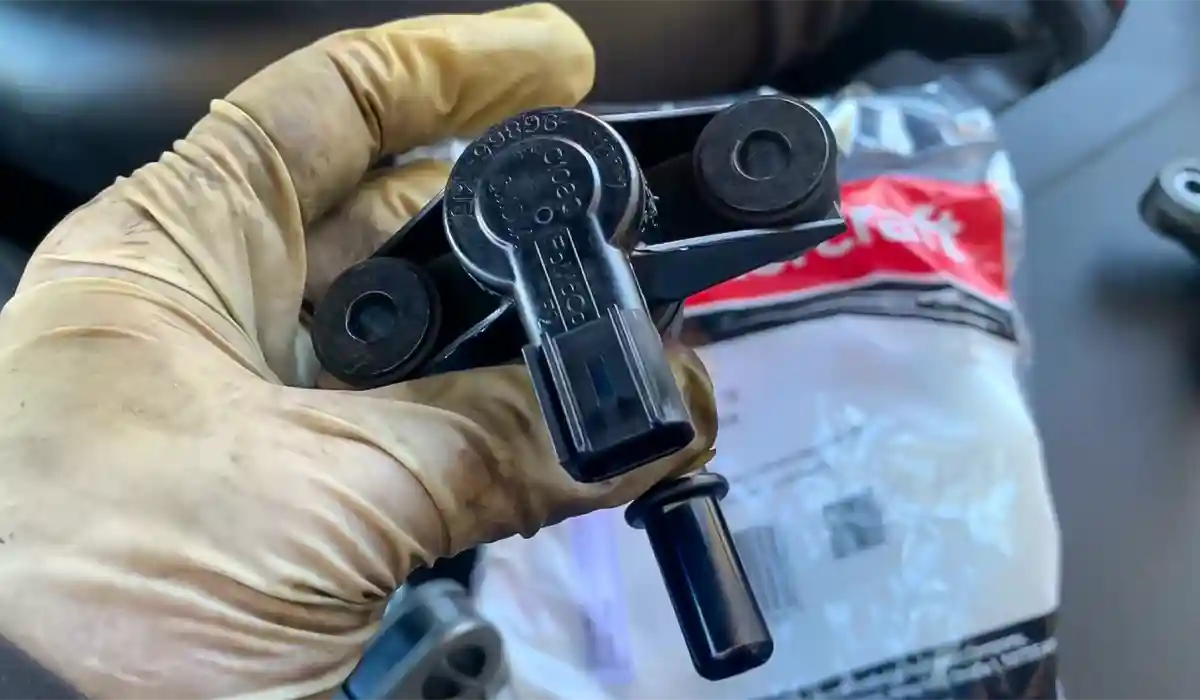
Under the hood, locate the purge valve (usually a small black plastic component with two hoses and a cable socket). Remove the hoses with the engine off and try blowing through it. A healthy valve should be tightly closed when not powered; if you can blow air through it, it’s bad and needs to be replaced. - Step 4: Low Pressure Smoke Test (The Gold Standard)
If visual inspection proves ineffective, a smoke test is the best and most accurate method. A special smoke machine injects a thick, environmentally friendly smoke at very low pressure (below 1 PSI) into the sealed EVAP system. Simply shine a bright flashlight under the car in a well-ventilated area. Wherever you see thin smoke escaping, that’s where your needle leak is!
Ford P0456 Evap Very Small Code
When your Ford computer system displays the Ford P0456 Evap Very Small Code, it means your car’s internal emissions monitoring system has been working very precisely.
Ford programs its engine control module to perform very rigorous self-tests. The car’s computer won’t immediately turn on the Check Engine light upon the first, seemingly random, test failure. Typically, these leaks must be detected in two consecutive driving cycles before the computer is convinced there’s a real problem with the system and then displays a trouble code on your dashboard.
Ford P0456 Evap Very Small Evap Leak
Troubleshooting a Ford P0456 Evap Very Small Evap Leak requires an understanding of how the leak behaves. Because these leaks are so small, their behavior is often inconsistent.
Microcracks in rubber hoses or plastic seals can seal tightly during warm weather because the rubber expands. However, when temperatures drop significantly at night or in winter, the rubber shrinks and hardens, creating a tiny 0.020-inch crack that triggers the P0456 code. This is why your check engine light might come on on a cold morning and then go off on its own during a hot day.
Ford P0456 Evap Very Small Amount
You might be wondering how much gasoline vapor is escaping from that 0.020-inch hole. This leak represents a very small amount of vapor (Very Small Amount).
From a fuel economy standpoint, the amount of gasoline vapor lost through a P0456 leak over a full year of driving is less than half a gallon of gasoline. So, you won’t find yourself emptying your gas tank quickly just because of this code.
However, for the environment, the release of even the smallest amount of pure gasoline vapor into the air contributes directly to smog and air pollution. That’s why U.S. emissions standards require cars to detect leaks this small.
Ford P0456 Evap Very Small Leak Fix
When many people hear the word “fix,” they immediately imagine a draining repair shop bill. However, there’s good news: most P0456 repairs are easy and inexpensive to do yourself (DIY).
Let’s take a look at the estimated repair costs based on the cause:
- Tightening the Gas Cap: Cost \$0. Simply tighten your gas cap back on.
- Replacing a New (OEM) Gas Cap: Ranges from \$15 to \$70. Always use the original Ford factory gas cap to ensure a tight fit.
- Replacing a Damaged EVAP Hose: Parts cost approximately \$10 – \$90 (Total with installation approximately \$60 – \$300).
- Replacing the Purge Valve: Parts range from \$30 – \$130 (Total with installation is around \$80 – \$250). This is a very easy component to replace at home with basic beginner tools.
- Replacing Vent Valve: Parts around \$35 – \$140 (Total with installation around \$90 – \$280).
Ford P0456 Evap Very Small Leak Detected
When your OBD-II scanner displays the text Ford P0456 Evap Very Small Leak Detected, this is an indication that your computer system is successfully performing its monitoring duties.
Ford’s computer detects these leaks by creating a slight vacuum in your fuel tank. The computer opens the purge valve while the engine is running to suck air out of the tank, then closes the entire valve completely.
The FTP sensor then monitors how long the system can maintain this vacuum. If the vacuum leaks or dissipates faster than the factory calculated standard, the computer registers a very small leak.
Ford P0456 Evap Very Small Low Pressure
One thing that beginners must understand: the EVAP system works at very low pressure (Low Pressure).
The operating pressure within these systems is typically only around 0.5 to 1 PSI. This is extremely low. Therefore, the number one safety rule when diagnosing an EVAP system is to never use a high-pressure garage air compressor to test for leaks! The excessively high air pressure from a standard compressor can damage the gas tank sensor, rupture the plastic charcoal canister, or even tear the internal hoses.
Always use a dedicated smoke machine equipped with a low-pressure regulator (such as the AutoLine Pro HyperSmoke, which is specifically regulated to below 1 PSI).
Ford P0456 Evap Very Small Leak Symptoms
Back to the topic of symptoms, why is the Ford P0456 Evap Very Small Leak Symptoms so difficult to detect without the aid of a scanner?
Because a 0.020-inch leak is too small to immediately affect your engine’s performance, your car won’t lose power when going uphill, the engine won’t stall, and you won’t see fuel dripping onto your garage floor. The only physical sign likely to appear on a Ford is a brightly lit dashboard indicator light.
This differs from a major leak (P0455), where gasoline vapors leak out in large quantities, causing a strong fuel odor around your car.
Ford P0456 Evap Very Small Problem
Although the Check Engine light often makes novice drivers cringe, in the world of mechanics, P0456 is often considered a very small problem.
Your car won’t stall in the middle of the highway due to this code. However, ignoring it in the long run is a bad decision. Why? Because if you leave your Check Engine light on for this minor issue, you’ll never know if a new, much more serious problem arises later such as a misfire or transmission failure because the warning light on your dashboard will have been on all along!
Ford P0456 Evap Very Small Spark
When it comes to automotive fuels, safety is a top priority. This is where the term “Spark” becomes crucial.
Even though the P0456 detects a very small vapor leak, gasoline vapor is still highly flammable. When performing a visual inspection of the gas tank, fuel pump under the rear seat, or fuel filler neck, ensure there are no open flames, cigarette butts, or sparks nearby!
If you are using portable power tools, ensure they are secure and do not produce sparks. Always perform repairs in an open, well-ventilated area for your safety.
Ford P0456 Evap Very Small Pressure
How does the computer measure such small pressure changes? Ford uses a Fuel Tank Pressure (FTP) sensor to monitor pressure changes in the fuel tank.
This sensor acts like a super-sensitive barometer. It sends an electrical voltage signal to the car’s computer based on the air pressure inside the tank. When the gas tank is tightly closed and the temperature changes (for example, when the car is parked in the hot sun), the air pressure inside the tank naturally increases.
If the EVAP system leaks, this pressure can’t be maintained and drops immediately to the ambient atmospheric pressure. The computer reads this sensor’s voltage change and determines there’s a leak.
Ford P0456 Evap Very Small Engine
Many beginners are confused as to why this code is called an “Engine Code”, even though the damage is in the fuel tank area.
The term Ford P0456 Evap Very Small Engine refers to the integration of this emissions system with your car’s engine. Although the gas tank is located at the rear of the car, the EVAP hose extends to the front engine compartment. Your car’s engine acts as a natural “vacuum cleaner,” utilizing the vacuum suction from the engine cylinders to draw gasoline vapors from the activated charcoal canister.
So, even though the physical leak may be at the rear of the car, the system is directly controlled by the engine’s computer and utilizes engine suction to recycle those fuel vapors.
Evap System Code P0456
To put the Evap System Code P0456 in proper context, let’s compare it to its counterparts in the EVAP code family so you don’t misdiagnose your car:
- P0455 (Large Leak Detected): A large leak, typically equivalent to a hole 0.080 inches in diameter. Often caused by a forgotten gas cap, a loose cap, or a disconnected main hose.
- P0442 (Small Leak Detected): A medium leak, equivalent to a hole approximately 0.040 inches in diameter. The diagnostic method and cause are almost identical to P0456, differing only in the leak tolerance threshold.
- P0457 (Fuel Cap Loose/Off): A specific code that detects that the gas tank has just been filled with fuel but the system detects a sudden large leak, which is almost certainly caused by a loose or missing fuel cap.
- P0446 (Vent Control Circuit): Not a physical leak problem, but rather an electrical failure in the vent valve (broken wire or burned solenoid coil).
P0456 Code Ford Escape
If you drive a popular SUV like the Ford Escape, this code is one of the most frequently reported problems by owners.
The modern-generation Ford Escape utilizes a fairly dense EVAP component layout under the vehicle’s chassis. The EVAP hoses on the Escape often pass close to the exhaust heat shield.
Over time, the constant heat radiation from the exhaust pipe can accelerate the aging of the hose rubber, causing it to crack and become brittle, ultimately triggering the P0456 code.
P0456 2017 Ford Escape
For 2017 Ford Escape owners, there’s one unique feature you should know about: Ford’s Capless Fueling System (Easy Fuel). The 2017 Ford Escape no longer uses the traditional twist-on gas cap. Instead, it uses a capless filler cap equipped with a spring-loaded metal flapper inside the fuel filler neck.
While this feature is very convenient because you don’t have to turn the gas cap when refueling, this *capless* system is very sensitive to dust, sand, and rust. If even a small grain of sand or dirt sticks to the rubber flapper seal, the valve won’t close properly. This microscopic gap is more than enough for the computer to detect a vapor leak and trigger a P0456 code.
Ford P0456 Engine Code
Understanding the Ford P0456 Engine Code means understanding the process of restoring your Check Engine light after repairs are made.
Many beginners are disappointed after cleaning the gas tank neck or replacing the purge valve, because as soon as they start the car, the Check Engine light remains red on the dashboard.
You should know that the P0456 code is a permanent emissions code. Your Ford’s computer needs time to re-run the “property test” before it’s confident the leak has been repaired. You’ll need to drive several normal drive cycles including city and highway driving with the tank’s fuel level between 15% and 85% for the computer to run the EVAP self-test at night. If the system detects the gas tank is airtight for several consecutive tests, the dashboard light will turn off automatically.
Ford Escape 2016 Code P0456
On 2016 Ford Escape models, especially those equipped with the EcoBoost engine (either the 1.6L, 1.5L, or 2.0L variants), the most common cause of the P0456 code is a leaking internally in the Canister Purge Valve.
The purge valve on an EcoBoost engine works extremely hard to withstand the air pressure from the turbocharger. Over time, the internal rubber membrane inside the purge valve can wear out or become clogged with small carbon debris from the deteriorating charcoal canister.
This causes gasoline vapors to continuously flow into the engine manifold even though the computer tells it to close. Replacing the purge valve on a 2016 Ford Escape is one of the best DIY projects for beginners because it’s easily accessible on top of the engine and only takes about 15 minutes.
Dodge Evap Code P0456
For an interesting automotive comparison, let’s look at how another American manufacturer, like Dodge, handles this emissions code. Dodge’s Evap Code P0456 operates on a slightly different diagnostic philosophy than Ford’s.
While Ford typically uses an electric leak detection pump (ELCM) or engine suction to test the system while driving, many Dodge models (such as the Dodge Ram 1500 or Chrysler 300) use a special device called an ESIM (Evaporative System Integrity Monitor).
The ESIM system in Dodge vehicles exploits the natural pressure changes in the gas tank caused by fluctuations in ambient air temperature when the car is parked overnight. As the gasoline cools overnight, it contracts, creating a natural vacuum in the tank. If your Dodge’s tank has a small leak (equivalent to 0.020 inches), this natural vacuum won’t form, and the ESIM sensor will immediately report it to the computer when you start the engine in the morning.
Ford F150 Code P0456
For those of you who own America’s best-selling vehicle, the Ford F-150 pickup truck (especially the 2015-2020 models with the 2.7L or 3.5L EcoBoost engine), the P0456 code is a fairly frequent visitor.
The F-150 is designed for heavy-duty work, off-roading, construction projects, and hauling heavy loads. Due to its tall and long chassis, EVAP components, such as the charcoal canister and vent valve, are mounted under the chassis near the rear axle or above the spare tire.
This placement makes the component highly susceptible to exposure to road dust, sand, muddy puddles, and sharp gravel. On the Ford F-150, fine dust often sneaks past the air filter vent valve, causing the vent valve to become stuck in a slightly open position.
Furthermore, the sensor cables under the truck are susceptible to being chewed by rodents (such as mice) seeking warmth at night, creating a vapor leak that triggers the P0456 code.
Ford P0456 EVAP Very Small Leak Prevention
Prevention is always better than having to struggle to find a pinhole-sized leak under your car. Here are some good habits from the American DIY community to prevent the P0456 code from appearing in the future:
- Never “Topping Off” When Filling Up! This is the most common mistake made by novice drivers. When you fill up at a gas station and the automatic fuel pump nozzle makes a *click*, stop filling immediately! Don’t force yourself to top up the amount to round up the payment amount. This habit of forcing the fuel to overflow will cause liquid gasoline to enter the vapor vent hose and flood the activated charcoal canister. The charcoal canister is designed to contain only vapor, not liquid. If this canister is soaked with liquid gasoline, the activated charcoal inside will disintegrate into a fine black powder that will clog the purge valve and vent valve, causing expensive damage to the EVAP system to repair.
- Clean the Gas Cap Seal Regularly: Every few months, take a clean, damp cloth and wipe down the rubber seal on your gas cap and the metal surface of your car’s fuel filler neck. Removing dust and residual gasoline evaporation will keep the tank seal airtight.
- Use a High-Quality Gas Cap: If you need to replace your gas cap, avoid cheap, off-brand, universal products. Always use Ford Motorcraft OEM (Original Equipment Manufacturer) parts to ensure proper fit and durability of the seal.
Verdict
Ultimately, the Ford P0456 code isn’t a scary thing that should make you panic or rush out to the repair shop to spend hundreds of dollars.
As a beginner, this guide key to dealing with this code is patience and structured diagnosis. Remember this golden rule: always start by checking your gas cap, cleaning the capless filler valve if your Ford uses one, checking the EVAP hoses easily accessible from the hood, and if the problem persists, performing a low-pressure smoke test to accurately locate any microscopic leaks.
By understanding how the EVAP system works and not rushing into replacing expensive components without testing first, you will not only save your Ford from environmental pollution but also save your wallet from wasted expenses!
FAQ: People Also Ask Ford P0456 EVAP Very Small Leak
Q: What does the "evap system small leak po456" code mean?
A: A P0456 diagnostic trouble code means your car's computer detected a very small leak (about the size of a pinhole or 0.020 inches) in the Evaporative Emission (EVAP) system
Q: How to fix evap system leak detected very small leak?
A: To fix a very small EVAP system leak (often designated by OBD-II code P0456 or P0442), start by inspecting and tightening or replacing the gas cap, as it is the most common and easiest culprit.
Q: How to fix a small evap leak on a capless gas tank?
A: To fix a small evaporative emission (EVAP) leak on a capless gas tank, you must clean and lubricate the internal sealing flap in the filler neck to restore its airtight seal.


