
Ford P0316 Misfire at Startup: For gearheads and car owners alike, there’s nothing more frustrating than starting your Ford on a cold morning, feeling the engine shudder, and suddenly seeing the Check Engine Light (CEL) illuminate brightly on the dashboard. Your engine starts roughly, shudders for a minute, and then suddenly returns to normal as if nothing ever happened.
However, the check engine light remains on. If this scenario sounds familiar, you’re probably dealing with one of the most challenging diagnostic codes to track down in the automotive world: Ford P0316.
This code is particularly tricky because its symptoms often disappear before you even back the car out of the garage. This article will dig deep into what’s really going on under the hood, why you shouldn’t ignore it, and how to fix it without resorting to a “parts cannon” (guessing and replacing parts that drain your wallet).
Ford P0316 Misfire at Startup Overview
Broadly speaking, P0316 is a specific code that indicates your vehicle’s engine computer has detected a misfire in one or more engine cylinders shortly after starting. Unlike typical misfire codes, which monitor the engine continuously, P0316 is very specific to the initial engine start-up timeframe.
Ignoring this code can be fatal, turning a simple spark plug issue into a $1,500 catalytic converter replacement. This guide will take you through the anatomy of the P0316 code in detail.
What is Ford P0316?
Ford P0316 is a standard OBD-II diagnostic code (although the definition can vary slightly between manufacturers, it is largely synonymous with Ford vehicles) that indicates that the Powertrain Control Module (PCM), or the car’s main computer, has detected a misfire during the first 1,000 revolutions of the engine upon starting.
These 1,000 revolutions take approximately 60 to 90 seconds of engine operation. The PCM uses the crankshaft position sensor (CKP) to monitor the crankshaft rotational speed. Each time a successful combustion explosion occurs in a cylinder, the crankshaft receives a small speed boost. If a cylinder fails to ignite (misfire), this boost does not occur, and the PCM detects the speed drop and registers the code P0316.
Meaning of P0316
The meaning of P0316 is closely related to timing. What differentiates this code from P0300 (random misfire) or P0301-P0310 (cylinder-specific misfire) is its monitoring window. The P0316 code only monitors the initial window at startup. This initial 1,000-rpm window is crucial because the engine is operating in open-loop mode.
In an open-loop system, the engine essentially guesses how much fuel to inject based on a computer basemap, because the oxygen sensors (O2 sensors) haven’t yet reached a hot enough operating temperature to provide live feedback.
Because the sensors can’t yet provide feedback, the engine has no way to compensate for an imbalanced fuel/air mixture. If a cylinder fails to ignite the mixture, the P0316 code will appear.
Ford P0316 Misfire at Startup Symptoms
You’ll usually notice it immediately when an engine cylinder misfires at idle in the morning. Here are the most common symptoms of the P0316 code:
- Engine Jerks and Vibrations: The engine will stutter or almost stall shortly after starting. This vibration is very noticeable inside the cabin.
- Check Engine Light (CEL) On or Flashing: This is the primary indicator. Remember the golden rule of mechanics: a steady CEL means a code is stored, but a flashing CEL is an emergency signal that a misfire is occurring and raw fuel is damaging your catalytic converter.
- Decreased Performance and Efficiency: Lack of power during initial acceleration and increased fuel consumption.
- Abnormal Exhaust Smoke: You may notice white, blue, or black smoke coming from the exhaust when the engine is cold, which indicates the presence of fluid (excess fuel, oil, or coolant) in the combustion chamber.
Ford P0316 Misfire at Startup Causes
The causes of P0316 vary widely, ranging from basic ignition component issues to severe internal mechanical failure. According to data from professional technicians, the following are the most common causes:
- Worn Spark Plugs (40% of Cases): This is the number one cause of trouble across the Ford engine lineup. As spark plugs age, their electrodes erode and their gap widens. During cold starts, resistance in the combustion chamber is higher and the fuel/air mixture is richer. Spark plugs with gaps that are too wide cannot produce a strong enough spark to ignite.
- Failing Ignition Coils (Weak Ignition Coil – 20% of Cases): The internal resin insulation of the Coil-on-Plug (COP) will degrade after thousands of heat cycles. The coil may fail when cold but work perfectly after the engine is warm, which is the classic pattern of P0316. Moisture or water entering the spark plug hole is also a major killer of coils.
- Fuel Delivery Problems (Injector/Fuel Problems – 10% of Cases): Dirty injectors spray fuel in a stream instead of a fine mist. A cold engine can’t vaporize these large droplets, causing poor combustion. Additionally, leaking injectors can flood the cylinders with fuel after the engine is shut off, ensuring P0316 appears on the next start.
- EcoBoost Coolant Intrusion (Coolant Leak – 10% of Cases): This is a nightmare for owners of 1.5L and 2.0L EcoBoost engines (2014-2019). The cylinder head gasket loses its seal, allowing coolant to enter the cylinders when the car is parked. During startup, the spark plugs fire into the fluid, causing the engine to stutter and emit white smoke.
- PCM Software Issues (15% of Cases): Sometimes, the factory software calibration is too sensitive. For example, on a 2021 F-150 2.7L EcoBoost, the PCM triggered a P0316 even though there was no apparent misfire. The only solution was a software update.
- Low Battery Voltage: Battery voltage dropping below 10.5 volts while the starter motor is working hard can prevent the PCM from accurately processing sensor data, mimicking the fluctuating crankshaft speed symptoms of a real misfire.
Ford P0316 Misfire at Startup Diagnostics
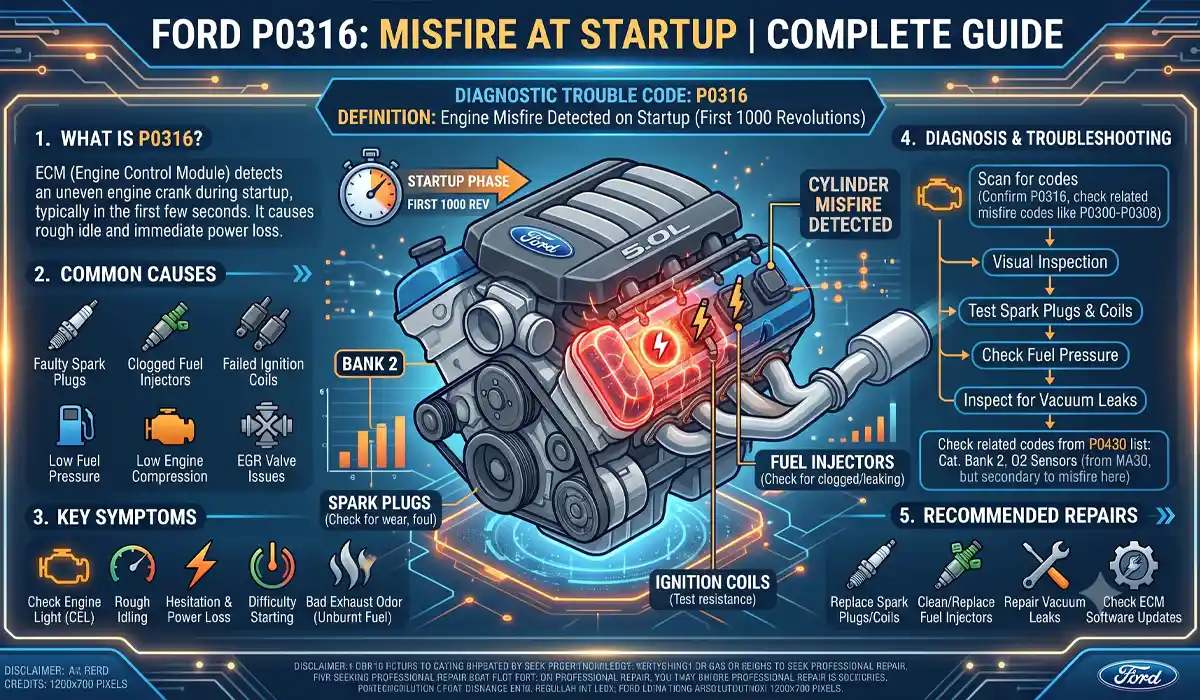
Throwing money away by guessing at the components for P0316 is amateurish. Take a structured approach to diagnosis like a certified mechanic:
- Read Freeze-Frame & Mode 6 Data: Use an advanced OBD-II scanner. Review the exact conditions when the P0316 error occurred. Mode 6 data is vital because it will show the specific misfire count for each cylinder, which will identify the problem cylinder before you even open the hood.
- Perform a Swap Test: If Mode 6 indicates a problem with cylinder 3, move the coil and spark plug from cylinder 3 to another cylinder (e.g., cylinder 1). If the misfire code moves to cylinder 1, then that component is the culprit.
- Fuel Pressure Test: Connect a fuel pressure gauge to the fuel rail, apply pressure, and turn off the engine. A rapid pressure drop indicates a leaking injector or a faulty fuel pump check valve.
- Internal Mechanical Inspection: For EcoBoost engines, test the cooling system pressure overnight, then use a borescope to look for water/coolant pools in the cylinders. Also perform a relative compression test.
Ford P0316 Misfire At Startup Fix
The solution to this problem depends largely on the root cause, but the most common and effective fix is replacing the spark plugs and ignition coils (tuning up the ignition components). Using a magnetic spark plug socket set and a gap tool is essential for this job.
On engines like the Ford Explorer 4.6L V8, replacing the spark plugs has been shown to resolve the P0316 code. On some direct injection engines like the Ford 3.5L EcoBoost, the solution may involve walnut blasting to remove thick carbon buildup on the intake valves, followed by the addition of a high-quality fuel additive.
Ford P0316 Misfire At Startup No Codes
What if your Ford engine vibrates heavily upon starting, but the system doesn’t set cylinder-specific misfire codes like P0301 through P0308, and instead just sets a pure P0316? In some scenarios, the PCM will simply set a P0316 code without any additional codes if the misfire duration isn’t consistent enough for the PCM to confidently pinpoint a specific cylinder.
This is why you should use a scan tool capable of reading Pending codes or Mode 6 data. Pending codes haven’t triggered the main CEL yet, but they’ve been recorded by the system and can guide you to which cylinder is firing erratically.
Ford P0316 Misfire At Startup Then Stops
One of the most common symptoms of P0316 is a misfire on initial start-up, then suddenly stops misfiring. Why does this happen? It comes down to the open-loop principle and the physics of a cold engine. When a cold engine requires a richer fuel mixture and a stronger spark. If the spark plug is slightly weak, it may fail to ignite the fuel mixture in the dense, cold air.
Additionally, water or condensation that collects in the spark plug well can create a “shortcut” for electricity to jump to the engine block instead of the spark plug tip. As the engine warms up in the first few minutes, the moisture evaporates and the spark plug returns to normal operation. The problem goes away, but the digital trace (P0316) remains.
Ford P0316 Misfire At Startup Then Dies
If the engine misfires during startup and then dies, you’re dealing with a more serious problem than just worn spark plugs. This is usually caused by two extreme possibilities:
First, a significant loss of fuel pressure. A worn check valve on a fuel pump allows the pressure to drop back to zero overnight.
When the pump attempts to restore pressure while the engine is cranking, the pressure is still too low, causing lean misfires and ultimately stalling the engine due to fuel starvation.
Second, the PCM’s failsafe mechanism. If the PCM detects a severe misfire that could melt the catalytic converter, the system automatically cuts off fuel supply to that cylinder to prevent further damage. This cutoff can cause the engine to rev too low, ultimately leading to a stall.
Ford P0316 Misfire At Startup Causes
Speaking of specific causes within the Ford manufacturing realm, we have to look at the Technical Service Bulletins (TSB) released by the manufacturer:
- Ford 5.4L 3V Triton: On this legendary engine, P0316 is often caused by a failed cam phaser, producing a ticking noise during the first few seconds of startup (TSB 10-11-2).
- Ford 5.0L Coyote (Mustang 2011-2014): A strange problem where the PCM misreads the signal from the crankshaft position sensor. The solution is often simply to install an additional O-ring on the sensor (TSB 13-6-15).
- Ford Ranger (2019-2022): The engine compartment design allows water to infiltrate directly into the spark plug wells. The solution is to install a decorative plastic engine cover (TSB 22-2025).
- EcoBoost Turbo Engines: Combustion chamber pressure from the turbo can “blow out” the spark from spark plugs that are not gapped perfectly at exactly 1.0 mm (TSB 18-2093 for Focus ST).
Ford P0316 Misfire At Startup When Cold
When exposed to cold temperatures, internal combustion engines are particularly vulnerable. Winter gasoline is blended to increase vaporization. However, if there is a sudden, extreme temperature drop, the fuel may not vaporize properly and form liquid droplets.
E85 (Flex-Fuel) engines are particularly affected by cold weather because ethanol requires significant heat to vaporize. On the F-150 Coyote 5.0L, this poor injector flow variation is amplified when the engine freezes, often triggering P0316 (and P0303). Cold starts put all mechanical, sensory, and ignition components under maximum stress.
Ford P0316 Misfire At Startup And Stop
As mentioned earlier, misfires at startup that then stop are a classic symptom of P0316. The PCM strictly only counts these incidents within the first 1,000 rpm. If a cylinder that’s been wet with oil due to a leaking valve seal overnight fires, the oil will coat the tip of the spark plug.
After about a minute of running, the combustion temperature will burn the wet oil buildup off the spark plug, and combustion will return to normal. Since there are no further misfires beyond those 1,000 rpm, you won’t receive a P0300 code for that run.
P0316 Misfire Detected On Startup
The technical description “Misfire Detected On Startup (First 1000 Revolutions)” should not be underestimated. Why is this period so critical? When a startup misfire occurs, unburned fuel is pushed out the exhaust valve and directly into the still-cold catalytic converter.
Once the converter reaches operating temperature (which can exceed 1000 degrees Fahrenheit), the remaining fuel explodes and ignites inside. This temperature surge can melt the internal honeycomb structure of the expensive catalytic converter, permanently destroying it.
P0316 Engine Code Ford
Many people ask, why is this code so often associated with the Ford brand? The answer lies in the programming architecture of the Ford PCM itself. While P0316 is a generic SAE (Society of Automotive Engineers) OBD-II code, Ford’s PCM is specifically programmed to be highly sensitive to crankshaft rotation fluctuations during the first 1,000 rpm.
Because of this sensitivity, Ford vehicles ranging from the F-150, Mustang, Explorer, and Escape are highly susceptible to triggering the P0316 diagnostic code.
Ford Fault Code P0316
Facing this “Fault Code” can be interpreted as a message from the PCM that your engine is experiencing premature stress. If you encounter this code along with a flashing Check Engine Light, you should immediately reduce engine load and pull over safely.
A flashing light indicates that the misfire rate is at a very destructive stage and could potentially cause serious mechanical damage to your vehicle’s exhaust system and turbocharger.
Ford P0316 Code Fix
Speaking of repairs, the cost to clear the P0316 code varies widely. Based on US estimates, if the problem is something as simple as a spark plug or crankshaft sensor, the cost ranges from $35 to $240 for parts and labor.
Replacing an ignition coil typically costs between $50 and $150 per unit. However, if the problem is a high-pressure fuel pump or head gasket that requires an engine replacement (especially in the case of EcoBoost coolant intrusion), the bill can balloon to $1,300 or even more than $1,800.
How Do I Fix Code P0316
For those of you who are DIY-ers who want to work alone in your home garage, start with these easy and inexpensive steps:
- Replace Spark Plugs: Make sure you use OEM spark plugs, check the gap with a gap tool according to factory specifications.
- Visual Inspection of the Coil: Look for carbon tracking or cracks in the coil’s resin insulation body. Apply dielectric grease to the coil boot during installation to repel water.
- Check the Battery: Test the voltage while the engine is cranking. If it falls below 10.5 volts, replace your vehicle’s battery.
- Check CKP Sensor: Disconnect the Crankshaft Position Sensor connector and test its resistance using a multimeter, replace if the value is outside the manual specifications.
What Causes Code P0316
To recap the causes of this code, remember that in addition to worn mechanical components like piston rings or valve seals (oil leaks), or a dead coil, external factors like fuel quality also play a role. If you frequently fill up with cheap fuel, deposits can build up in the injector lines.
This causes the fuel mist to be obstructed. If the engine doesn’t receive a fine mist of fuel when cold, the ignition process fails, leading to a startup misfire. Sometimes, the engine’s “brain,” or PCM, is out of date, and the sensor is overly sensitive to detecting micro-delays in engine speed.
Ford P0316 Misfire at Startup Prevention
Proactive maintenance is the best mantra for modern machines.
- Use Top Tier Fuel: Top Tier gasoline has a higher detergent content than the standard legal grade. This keeps injectors clean and prevents carbon buildup on the intake valves, especially in direct-injection engines.
- Spark Plug Replacement Schedule: Don’t wait for the manufacturer’s 100,000-mile requirement if you’re using an EcoBoost engine. Experience shows that spark plugs in high-output turbo engines should be replaced every 30,000 to 45,000 miles.
- Monitor Radiator Water (Coolant): If you own a Fusion or Escape EcoBoost (2014-2019), check your coolant reservoir level weekly. Catching a leak early can save you from total engine failure or hydrolock.
Verdict
A Ford P0316 code is more than a rough cold start—it’s your engine’s early warning that something needs attention before it turns into a costly repair. In many cases, fixing worn spark plugs, weak ignition coils, or fuel delivery issues early can prevent damage to the catalytic converter and keep your Ford running at its best. Use a proper diagnosis, fix the root cause, and never ignore a flashing Check Engine Light.
Ford P0316 may seem like a temporary issue that can be ignored—a little cough in the morning and smooth sailing the next. But in reality, the code acts as a critical early warning signal. Allowing a startup misfire to persist risks gradually pouring unburned fuel into your catalytic converter or turbocharger, causing thousands of dollars in damage.
If P0316 appears on your OBD-II scanner, address it immediately. Whether it’s with a simple spark plug and coil tune-up on the weekend or through the help of a professional technician, addressing it early will ensure the long-term durability and performance of your Ford engine. Never ignore a flashing light on your dashboard!
We’ll continue updating this guide as new Ford service information, TSBs, and repair solutions become available. If you found this article helpful, explore more expert Ford troubleshooting guides on our website and bookmark us to stay ahead with the latest automotive news, maintenance tips, and repair updates.
FAQ: People Also Ask Ford P0316 Misfire at Startup
Q: How do I fix the code P0316 on my Ford?
A: The Ford diagnostic trouble code P0316 means "Engine Misfire Detected on Startup (First 1,000 Revolutions)". It triggers when the computer detects erratic cylinder firing immediately after starting a cold engine.
Q: Why does my car misfire when I first start it?
A: An engine misfires on a cold start because the air-fuel mixture fails to ignite properly. When the engine is cold, the most common culprits are worn spark plugs, failing ignition coils, a small vacuum leak, a clogged fuel injector, or carbon buildup on the intake valves.
Q: Can a faulty fuel injector trigger P0316?
A: Code P0316 means your engine misfired during its first 1000 revolutions after starting. Common causes: Spark plugs/coils (60%), fuel injector (20%), low fuel pressure (10%).


