
Ford P0455 Large Evap Leak: Halo loyal FordTrend readers and Ford owners! Nothing could be more damagingmood moment cruisingon the toll road besides seeing the lightsCheck Engine Light(CEL) suddenly lights up bright yellow on your dashboard. If you immediately pull over, plug in your favorite OBD-II scanner, and the screen shows the code P0455, take a deep breath.
The good news? Your Ford engine won’t explode, and your transmission is safe. However, the bad news is that your vehicle has just failed its internal emissions system test. The P0455 code is one of the most frequently searched OBD-II error codes by drivers worldwide, with tens of thousands of searches each month.
In this American mechanic style article, we will thoroughly dissect everything about Ford P0455, from what it means, to the myths surrounding it.Catalyst Bank 2, to how to diagnose and fix it like a true professional so you don’t waste hundreds of dollars on it.dealership.
Ford P0455 Large EVAP Leak Overview
Before we get into the dirty parts under the hood, let’s understand the big picture. Modern vehicles are equipped with a system calledEvaporative Emission Control System often abbreviated asEVAP. Since the 1970s, federal emissions regulations in the United States have required automakers to ensure that highly volatile gasoline vapors do not leak into the atmosphere.

These vapors contain harmful hydrocarbons that contribute to smog formation. The EVAP system works by capturing fuel vapors from the tank, storing them in a charcoal canister, and then, at the appropriate time, sucking the vapors back into the engine’s combustion chamber to be burned with the fuel and air mixture.
This system is completely sealed, and your car’s computer regularly tests it to ensure there are no leaks.
What Is Ford P0455?
On Ford vehicles such as the F-150, Explorer, Mustang, or Escape, P0455 indicates thatPowertrain Control Module The (PCM) or engine computer detects a large leak in the EVAP system.
When the PCM executes the procedure self-test, it will close the EVAP system usingvent valveand apply vacuum pressure from the machine usingpurge valve. The computer then monitors whether the system can withstand the vacuum.
If the vacuum pressure dissipates too quickly, the computer concludes that air is entering from outside through a large hole or gap. This is where the Ford P0455 code is triggered and your check engine light comes on.
Ford P0455 Large EVAP Leak Meaning
Technically, the official definition of OBD-II code P0455 is”Evaporative Emission Control System Leak Detected (Large Leak) / (Gross Leak)”. The words “Large” or “Gross” here have specific technical measurements.
Different from its sibling code, namely P0442 (small leak /small leak), P0455 means the system has detected a leak equivalent to a hole 0.040 inches to 0.080 inches (about 1 to 2 millimeters) in diameter or larger.
While 2 millimeters may sound small to the naked eye about the size of a mechanical pencil lead in a pressurized EVAP system it is a huge gap and renders the system completely incapable of holding the required vacuum pressure.
Ford P0455 Large EVAP Leak Symptoms
P0455 is an emission code, which means the problem is isolated to the vapor recovery system and completely affects how your engine starts, accelerates, or shifts gears. However, you may notice some of the following symptoms:
- Check Engine Light is Solid:This is a symptom that occurs in 100% of P0455 cases.
- Fuel Odor:Because this is a large leak, raw gasoline vapors often escape into the air. You may notice a strong gasoline odor around the rear wheel wells, the gas tank, or even inside the cabin when the car is parked in the garage.
- Failed Smog Test:If you live in an area with strict emissions standards like California, the P0455 code will automatically cause your vehicle to fail the emissions test.
- Hissing Sound:In some severe cases, you may hear a hissing sound from the fuel tank area as the system tries to suck in air.
- Difficult to Fill Gas:If the cause is a stuck vent valve, you may experience a persistent “clicking” or stalling fuel pump nozzle while refueling.
Ford P0455 Large EVAP Leak Leak Causes
The EVAP system has many components, and major leaks can occur anywhere along its path. The most common causes include:
- Loose or Damaged Gas Cap:This is the number one cause and accounts for approximately 30-40% of all P0455 cases. If you don’t turn the cap until it clicks, or if the rubber seal has cracked with age, this code will appear immediately.
- Purge Valve Stuck Open:This valve is located near the engine. If it becomes stuck in the open position due to carbon buildup, it creates a constant air leak that the system considers a “Large Leak.”
- Vent Valve (Solenoid) Rusak:A stuck vent valve will not be able to close the system for testing, causing a vacuum to fail to form.
- Cracked Charcoal Canister: Physical damage due to hitting rocks on the road or hitting speed bumps that are too high can break this plastic tube.
- EVAP Hose Cracked or Leaking: Rubber hoses that age and harden due to extreme heat often break or come loose from their fittings.
- Rusty Fuel Filler Neck: Corrosion on the filler neck metal can damage the seal where the gas cap sits.
Ford P0455 Large EVAP Leak Diagnosis
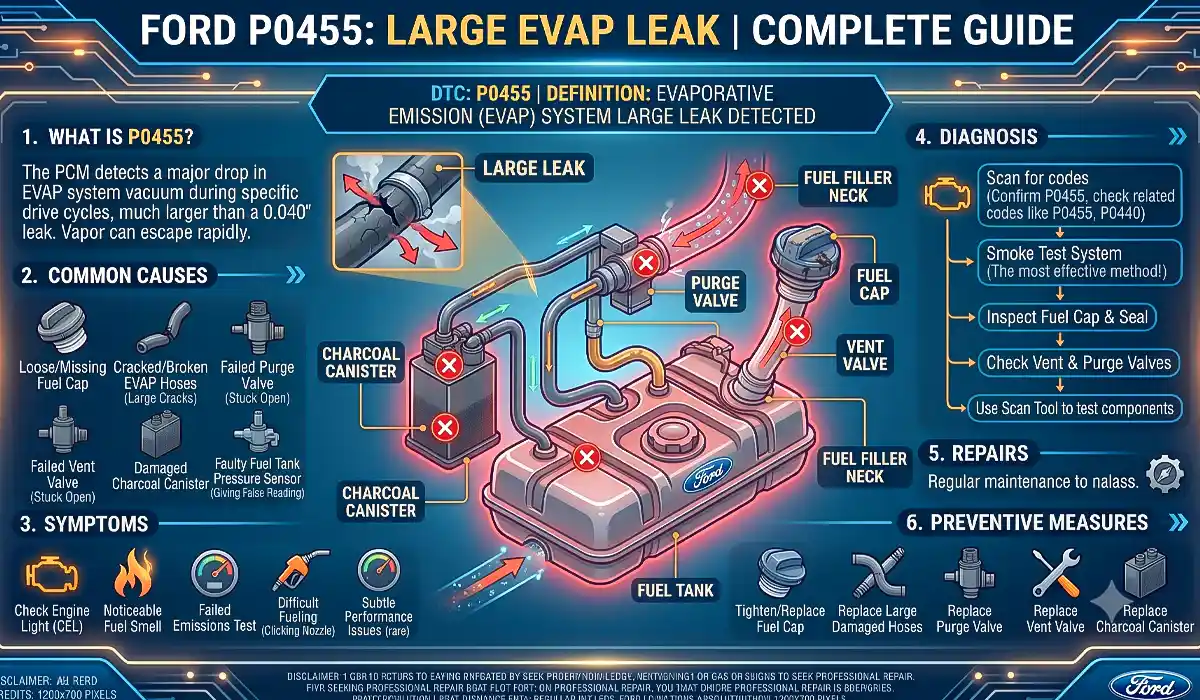
Many people simply guess and resort to parts-swapping. Professional mechanics in America don’t do that. Here are the proper diagnostic steps:
- Step 1: Check the Gas Cap. Always start with the cheapest. Open the gas cap and check the rubber O-ring. If it’s hard, cracked, or you just filled it with gas and forgot to tighten it, tighten it or replace it.
- Step 2: Visual Inspection. Lift the car and inspect it with the naked eye. Are there any loose hoses in the engine compartment? Is the canister under the car broken?
- Step 3: Scan Tool & Bi-Directional Control. Use scanner level dealership to orderpurge valve And vent valveclose electronically, then listen for a click.
- Step 4: Smoke Test. This is Gold StandardThe (Gold Standard) in the automotive mechanic world. The mechanic will pump safe, artificial smoke (mineral oil-based) into the EVAP system at low pressure (0.5 to 1.0 PSI). Because this is a “Large Leak,” smoke will usually billow out very clearly from the leak point. There’s no more guesswork; where the smoke comes out is where the problem is.
Important: We often see very confusing internet searches from drivers who confuse EVAP codes (P0455) with Catalyst codes (P0420/P0430). The sections below are dedicated to completely clearing up this misconception for your Ford vehicle.
Ford P0455 Catalyst Bank 2 Sensor 1
Many drivers panic when they look up the P0455 code and find the manual online fake that leads him to Catalyst Bank 2 Sensor 1. Let’s get this straight: P0455 has absolutely nothing to do with the Catalytic Converter or the Oxygen Sensor (O2 Sensor).
Sensor 1 (Upstream Sensor) is used to monitor the fuel-to-air ratio in the exhaust. P0455 is a gasoline vapor leak code. If you’re making this claim, ignore it. Your Ford engine is complaining about gasoline vapors, not exhaust fumes.
Ford P0455 Catalyst Bank 2 Sensor 2
Same thing with Sensor 2. “Sensor 2” is the Oxygen sensor.DownstreamLocated after the catalytic converter, its function is to check the catalyst’s efficiency. Finding a P0455 sensor issue is like going to the dentist for a sore knee.
Ford P0455 Catalyst Bank 2 Location
The location of Bank 2 on a Ford V6 or V8 engine (such as the F-150 with the 5.0L Coyote or EcoBoost engine) is generally on the driver’s side.
However, remember, you will find an EVAP leak (P0455) on the engine block or exhaust Bank 2! The P0455 leak is localized in the fuel hose route, starting from the tank cap on the car body, down to Charcoal Canister (which is usually hidden under the truck bed or near the gas tank), to the hosepurge valve on the intake manifold.
P0455 Catalyst System Bank 2
Search term “P0455 Catalyst System Bank 2” is a myth orglitchCommon in low-cost scanner applications. The EVAP system does not use a “bank” system like the exhaust. The vehicle’s fuel system is a single entity that serves the entire engine.
If you see the warning “Catalyst System Bank 2”, it is likely that your car has another code stored, namelyP0430, simultaneously with P0455.
P0455 Catalyst System Low Efficiency Bank 2
This is a misnomer. “Catalyst System Low Efficiency Bank 2” is a standard definition that belongs exclusively to OBD-II codes P0430. P0455 is EVAP Large Leak.
If your Ford truck has both of these codes, it means your vehicle is suffering from two completely different problems: a major gasoline vapor system leak and internal damage to the driver-side catalytic converter. You’ll need to diagnose them separately.
P0455 Catalyst System Efficiency Below Bank 2
The “Efficiency Below Threshold” error occurs when the PCM sees the downstream Oxygen Sensor fluctuating too closely to the upstream sensor. This is an exhaust emissions warning (P0430).
You may fail the test because of this code, it’s the same as if you were experiencing P0455. However, fixing the EVAP will never fix your catalytic converter, and vice versa.
Ford P0455 Code Bank 2
There is no Bank 2 on P0455. EVAP is a vapor circuit loop closed-loop vapor circuit. Gasoline vapor from the tank is drawn into the intake manifold centrally, then distributed to all engine cylinders (both Bank 1 and Bank 2) to be burned simultaneously.
P0455 Ford F150 Bank 2
Let’s talk specifically about the Ford F-150. This legendary workhorse truck is often faced with the P0455 code. Some newer F-150s use this system.capless fuel filler(fuel filler without mechanical twist cap).
Dust or dirt that accumulates on the cover cap less This often causes a vacuum leak that triggers P0455. In addition, the F-150 is often used towing Heavy (pulling loads) sometimes experience small deformations in the fuel tank, which can also create a “Large Leak”. Don’t waste time checking the Bank 2 exhaust, check the system directly/capless or vent valve under your F-150.
P0455 Code Bank 2 Location Ford
If you are truly looking for a repair location for P0455 in a Ford vehicle (ignoring the misleading Bank 2 term), start at fuel filler neck (where you enter nozzle gas station).
From there, follow the hose down towards the Charcoal Canister On Ford vehicles, the canister is a black, rectangular tube that is mounted on a bracket near the frame or fuel tank on the underside of the vehicle.
P0455 Code Bank 2 Location Ford F150
In the Ford F-150, Purge Valve(or often called Vapor Management Valve / VMVby Ford) is usually located very easy to reach right in the engine compartment (under the hood), close to the intake manifold or firewall.
Meanwhile, Vent Valveits position is tightly attached to Charcoal CanisterUnder the cargo bed, protected near the fuel tank. This lower component is often the victim of gravel and mud.
P0455 Catalyst System Below Threshold Bank 2
Once again, let’s separate the boundaries. If your mechanic says your P0455 is caused by “Catalyst System Below Threshold Bank 2,” take your car keys and look for it.shop(workshop) another.
A basic mechanical understanding of the OBD-II emissions system is crucial; EVAP and Catalyst are two separate emissions worlds.
P0455 Code Bank 2
To conclude this myth: Ignore the “Bank 2” code if your engine only displays a P0455 code. P0455 stands for Large EVAP Leak. Repair the fuel system leak, and let the exhaust/catalytic converter (Banks 1 & 2) function properly.
How Do I Fix Code P0455
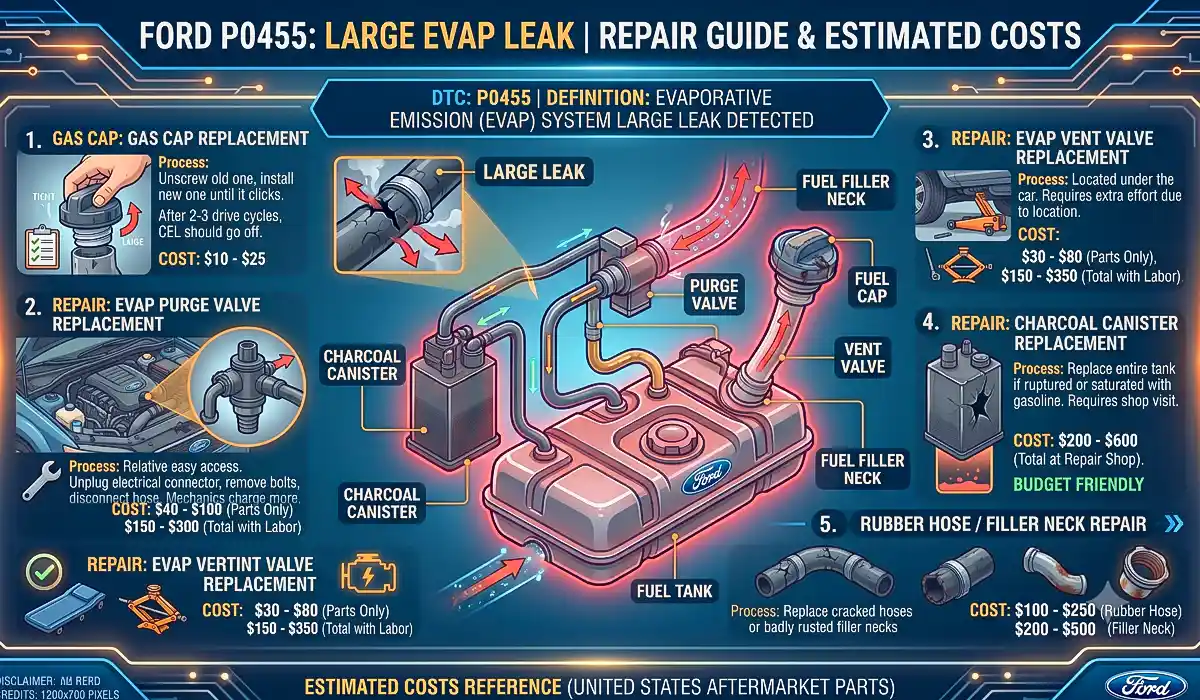
Fixing P0455 is often very budget friendly (DIY-friendly). Depending on the failed component, here’s a guide to costs and how to repair it in the United States (aftermarket parts pricing reference):
- Gas Cap Replacement: These components cost only $10 to $25. Simply unscrew the old one and install the new one until it clicks. If it does, after 2-3 times…drive cycle(drive cycle) CEL light is off, your repair is complete!.
- EVAP Purge Valve Replacement: This valve is relatively easy to access in the engine compartment.partsThe repair is usually around $40 to $100. The repair involves simply unplugging the electrical connector, removing the retaining bolts, and disconnecting the hose. Mechanics typically charge a total of $150 to $300, including labor.
- EVAP Vent Valve Replacement: Because it’s located under the car, it requires a bit of extra effort. The component costs $30 to $80, but because of its difficult location, the total repair cost can be $150 to $350.
- Charcoal Canister Replacement: If this tank ruptures or becomes saturated with gasoline, you’ll need to replace the entire tank. This can cost anywhere from $200 to $600 at a repair shop.
- Rubber Hose / Filler Neck Repair: A cracked hose can be replaced for $100 to $250.Filler neck which are badly rusted, the total replacement will cost $200 to $500.
If you use a professional repair shop, they will usually charge an additional $80 to $150 to do the job.
Smoke Test(smoke test). Don’t refuse this test; it is thanks to the smoke that the mechanic will not replace the car carelessly.partswhich is not actually damaged, saving your wallet from blind guessing.
What Causes Code P0455
So, what triggers the damage to these components? Several habits and external factors can silently damage the EVAP system:
- Topping Off The Tank (Filling Gasoline Until It Overflows):This is a cardinal sin in the automotive world. When the fuel pump automatically makes a “click” sound, stop pressing its nozzle forcing more gasoline to round up the price can force liquid fuel into the EVAP vapor line. Liquid gasoline will flood the activated charcoal inside the canister, permanently damaging it and causing cracks due to expansion.
- Environmental and Weather Conditions: Extreme daily temperature changes (cold in the morning, scorching heat in the afternoon) will cause the rubber O-ring and EVAP drain hose to expand and contract. Eventually, the rubber loses its elasticity, fine cracks appear, and a major P0455 leak occurs.
- Off-roading: For those of you who own a Ford truck or SUV who like to play on dirt roads or off-road, the canister tube under the car is very vulnerable to being punctured by wooden branches or being hit by large rocks.
- Rat Bite (Rodent Damage): Amazing but true, mice sheltering in the warm engine compartment or undercarriage of a car often chew through the rubber EVAP hose and electrical wiring, creating a large hole in an instant.
Ford P0455 Large Evap Leak Prevention
Maintenance is key to preventing the Check Engine light from haunting your journey. Here are effective ways to prevent the P0455 code:
- Tighten the Gas Cap Correctly: This may sound silly, but make it a habit to turn the gas cap until you hear at least two to three loud “clicks” after filling.
- Replace Gas Cap Every 5 Years: Just like tires and wipers, the rubber O-ring on the gas cap has a lifespan. Proactively replacing it (for just $15) every five years is a low-cost insurance investment against the P0455 code.
- Don’t Top Off Gasoline: Get used to it; when the fuel pump shuts off by itself, unplug the nozzle. Love your Charcoal Canister.
- Protector Under carriage: Pay attention to your driving style when passing over speed bumps or when playing off-road. Do not let road stones hit the components around the gas tank.
Verdict
A Ford P0455 code isn’t a reason to panic, but it is a warning you shouldn’t ignore. In most cases, the fix is surprisingly simple, from replacing a worn gas cap to repairing a damaged EVAP hose or valve. A careful diagnosis will save you time, money, and unnecessary parts replacement while keeping your Ford running clean and reliable.
Seeing a P0455 code on the scanner screen is actually a lucky break compared to a fatal code like an engine misfire or internal transmission failure. Your Ford vehicle is very safe to drive in the short term even if the P0455 code is active, because this is purely an emission vapor issue and not an engine reliability issue.
However, don’t ignore this problem forever. Ignoring a large EVAP leak means you’re continually allowing dangerous (and potentially pungent and flammable) gasoline vapors to spread into the air and into your garage. Furthermore, you’ll likely fail your annual emissions test while this code is on.
Start with the least expensive step: check and replace your gas cap, then clear the trouble codes using an OBD-II scanner. If P0455 keeps showing up,dashboard, forget the guesswork. Bring your truck to a trusted shop, ask the mechanic to do it Smoke Testso that improvements can be right on target.
Keep driving safe and respect the road, gearheads!
We’ll continue updating this guide as new Ford service information, repair procedures, and technical insights become available. Be sure to explore more of our expert Ford troubleshooting guides, and bookmark our website so you never miss the latest automotive tips, maintenance advice, and repair updates.
FAQ: People Also Ask Ford P0455 Large Evap Leak
Q: Is it okay to drive with a large evap leak?
A: Yes, it is generally safe to drive for a short time, but you should get it repaired. The EVAP (Evaporative Emission Control) system captures fuel vapors so they can be burned in the engine rather than escaping into the atmosphere. Because it is strictly an emissions control system, it usually doesn't affect your engine's performance.
Q: How to fix evap system leak detected large leak?
A: Fixing a large EVAP (Evaporative Emission Control) system leak usually involves finding and replacing the gas cap, swapping out a failed purge or vent valve, or repairing a cracked vapor hose. Because a large leak means the system is completely failing to hold pressure, the easiest DIY fixes address the most common culprits first.
Q: Can a large evap leak be due to a vapor line?
A: EVAP leaks can occur in various components of the system: The gas cap (most common and easiest to fix) Vapor lines or hoses that have cracked or deteriorated. The charcoal canister that stores fuel vapors.


