
Ford P0174 System Too Lean: This time we’ll discuss the P0174 error code, which tells you that the vehicle’s engine control module (ECM) has detected that the fuel-to-air ratio in Bank 2 of the engine is too lean. (Bank 2 is the side of the engine that doesn’t contain the first cylinder.)
This happens because there is too much air and not enough fuel, and this can cause the engine to misfire and increase combustion temperatures, and can even cause damage to vital components such as valves and pistons.
Ford P0174 System Too Lean: What does the Ford P0174 trouble code mean
The P0174 code on Ford vehicles indicates that the fuel injection system on bank 2 is running too lean. This means there is an imbalance in the air-fuel mixture delivered to the engine, with insufficient fuel being supplied compared to the amount of air.

This can lead to various performance issues, including poor acceleration, unstable engine revs, and reduced fuel efficiency. If left untreated, it can also cause potential engine damage over time.
Ford P0174 System Too Lean: Code Explanation
| P | Drive system |
| Engine, transmission, and emission control systems. | |
| 0 | Generic OBD-II |
| Standard code that applies to all vehicle brands. | |
| 1 | Fuel & Air Measurement |
| Related to the MAF sensor, O2 sensor, and air intake. | |
| 7 | Mixed Control |
| The ECU has detected a fuel mixture condition that is too lean or too rich. | |
| 4 | Bank 2 Too Thin |
| Too much air/too little fuel on Bank 2 |
What does Ford code P0174 actually mean?
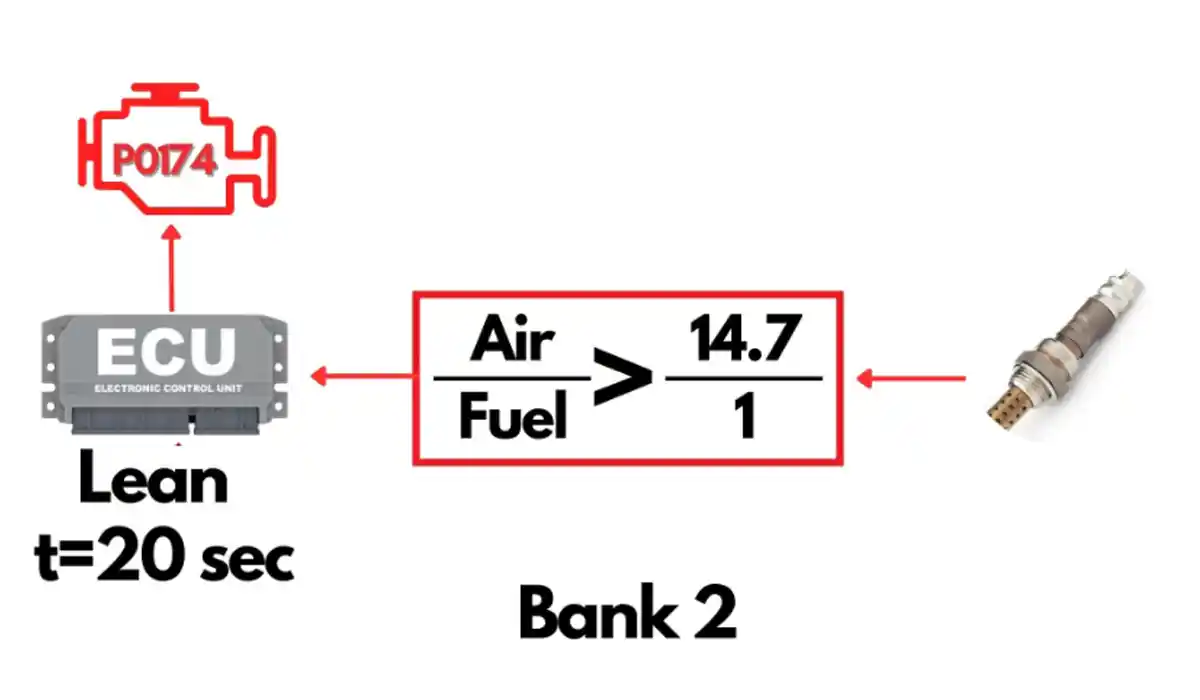
The Powertrain Control Module (CM) continuously monitors the air-fuel ratio via an upstream oxygen sensor. The ideal ratio is 14.7 parts air to 1 part fuel. When the mixture is too lean toward air, the PCM attempts to compensate by adding more fuel.
If it cannot correct the imbalance and the long term fuel adjustment rises above +15% to +35% it will store a P0174 code and turn on the engine malfunction indicator lamp (MIL).
This isn’t just an annoying indicator light. An engine running on a lean fuel mixture will produce more heat, which can damage exhaust valves, melt pistons, and burn out your catalytic converter.
Fuel trim is the PCM’s (Powertrain Control Module’s) way of fine-tuning the air-fuel mixture in real time. There are two types you should be aware of:
Short-Term Fuel Adjustment (STFT): Reacts instantly to oxygen sensor data. Fluctuates several times per second.
Long-Term Fuel Trim (LTFT): Adjustments that the PCM (Powertrain Control Module) learns and stores over time to handle gradual engine changes.
When the LTFT on Bank 2 remains consistently high, the P0174 code appears. Here’s a quick reference:
| Fuel Adjustment Parameters | Healthy Range | P0174 Trigger |
| Short-Term Fuel Adjustment (STFT) | -5% to +5% | High positive surge |
| Long Term Fuel Adjustment (LTFT) | 1% to 2% | +15% to +35% (Bank 2) |
| Total Fuel Adjustment (STFT + LTFT) | Below 10% | Above 25% |
| Upstream O2 Sensor Voltage | 0.1V – 0.9V (depending on the power) | Stuck below 0.45V |
Reading fuel adjustment data directly with a scan tool gives you the quickest clues to what’s wrong before you touch a single bolt.
Where exactly is Bank 2 located on your Ford?
This is often confusing for many people. Bank 1 always contains Cylinder 1. Bank 2 is the opposite side. But which side is physically located depends on your engine’s position within the engine bay.
| Ford Engine Configuration | Bank Location 1 | Bank Location 2 | General Model |
| V8 Elongated | Passenger side | Driver's side | F-150, Mustang, Expedition |
| Longitudinal V6 | Passenger side | Driver's side | Ranger, old model Mustang |
| Transversal V6 | Passenger side (rear) | Radiator side (front) | Explorer, Edge, Escape, Flexible |
| Inline 4 cylinder engine | Only one bank | Not available | Focus, Fusion, Escape (I4) |
If you’re working on a transverse Ford Explorer V6, Bank 2 is located closest to the radiator at the front of the engine compartment. If installed incorrectly, you’ll replace the wrong sensor. Ask us how many people learned this the hard way.
When is the codeP0174 appear?
In a fully functional system,upstream oxygen sensor, which is also calledair-fuel ratio sensor, measures the amount of oxygen in exhaust gases as they exit the engine. This real-time data helps the Powertrain Control Module (PCM) adjust the air-fuel mixture for optimal performance.
For a gasoline engine, the ideal air-fuel ratio is14.7 parts air to 1 part fuelthis is known asstoichiometric ratio.When the mixture is at this ratio, combustion is efficient, and emissions are minimized.
However, when the oxygen sensor detects that the air-fuel ratio is more than 14.7:1 meaning there is too little fuel or too much air in the mixture the PCM interprets this as a ‘lean’ condition.
If this overly rich fuel mixture condition continues for a long period of time, the PCM will trigger a code. P0174, which shows that the system isBank 2running too lean (fuel mixture too low).
Where is the sensor located? P0174or oxygen sensor?
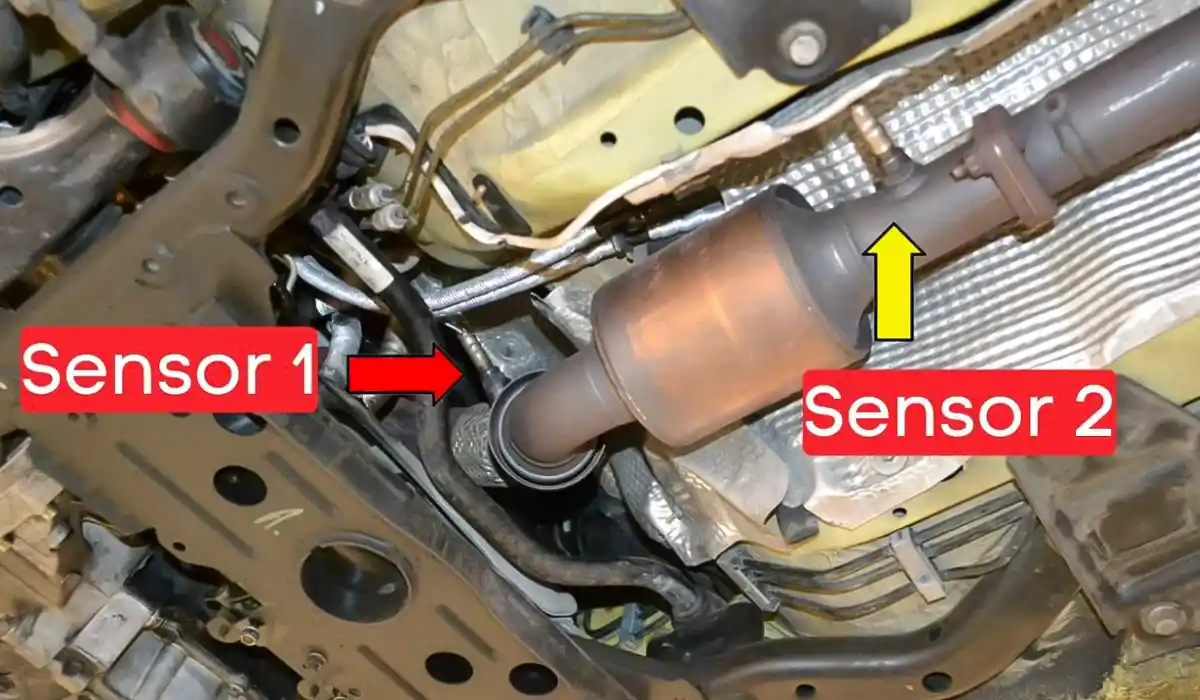
Sensor P0174, also known asOxygen Sensor or Air-Fuel Ratio Sensor, generally located in the exhaust system,upstreamcatalytic converter onBank 2.The position of this sensor may vary slightly depending on the make and model of your vehicle, but it is typically located near the exhaust manifold.
Ford P0174 System Too Lean: 3 Reasons Why Your Ford Is Displaying the Code
The P0174 code almost always stems from one of three things: air getting in where it shouldn’t, a sensor not providing accurate information about the amount of air getting in, or an insufficient amount of fuel getting in.
1, Vacuum Leaks: Main Causes
A vacuum leak allows air to enter the intake manifold past the MAF sensor. The PCM never detects this air, so it doesn’t add the appropriate amount of fuel. The result? Excess oxygen in the exhaust, and the P0174 error code appears.
On Ford’s 5.4L and 4.6L Triton V8 engines, the PCV elbow at the rear of the intake manifold is a known weak point. This part cracks due to heat and exposure to oil vapor. You’ll often hear this as a faint hiss when the engine is idling.
The intake manifold gasket is another common source of leaks—especially on engines with plastic manifolds. When the engine is cold, the leak often worsens before the metal expands and temporarily closes the gap.
Quick test: If your fuel adjustment is high at idle but drops to near zero at 2,500 RPM, you almost certainly have a vacuum leak. The volume of leaking air remains constant, but at higher RPMs, it becomes a small fraction of the total airflow.
2. Dirty or Damaged MAF Sensor
The MAF sensor measures the mass of incoming air by monitoring the flow through a heated platinum wire. Dust, oil from a wet aftermarket air filter, or simply age can coat the wire and slow its response.
A dirty MAF will report lower airflow. The PCM thinks less air is coming in, orders less fuel, and the mixture becomes lean. Unlike a vacuum leak, a dirty MAF will usually worsen at higher RPMs when airflow increases and the sensor can’t keep up.
3. Fuel Delivery Issues
Once the air side inspection has been performed, the next step is to check the fuel side. A clogged injector in Bank 2, especially on EcoBoost direct injection engines, can cause a lean fuel mixture in only one bank. Carbon buildup on direct injection injectors is a well-documented problem.
System-wide problems, such as a faulty fuel pump or clogged fuel filter, typically trigger the P0171 and P0174 codes simultaneously, rather than just one on one side.
Ford P0174 System Too Lean: Common symptoms of error code
- Your vehicle’s engine indicator light is on.
- The engine is having ignition problems or will not start properly.
- Engine speed at idle is unstable.
- Power and acceleration are reduced, or the vehicle stalls or stalls.
- You may notice a decrease in fuel efficiency.
- Vacuum leak
- Faulty oxygen sensor
- Dirty or clogged fuel injectors
- Fuel pump failure
- Exhaust leak before oxygen sensor
Ford P0174 System Too Lean: Symptoms on Ford
- Decreased fuel efficiency
- Engine vibrates at idle or suddenly dies
- The engine is experiencing combustion problems
- Check engine indicator light is on
- Lack of power or hesitation during acceleration
Is it safe to drive my car with error code P0174?
The answer is definitely no, at least not for a long time. Because an improper air-fuel ratio can cause damage to your engine components, the longer you drive with this problem unaddressed, the more likely you are to experience serious problems (and expensive repairs).
How to properly diagnose the P0174 error code on a Ford
Like all vehicle fault codes, the P0174 code is found through an OBD-II scanner, and the mechanic will perform a visual inspection of components such as the vehicle’s vacuum hoses and air intake system.
The mechanic will also check the vehicle’s fuel system and oxygen sensors, as well as the mass airflow sensor, to ensure they are correctly measuring the amount of air entering the engine.
However, it’s a good idea to consider the cost of replacing a component before asking a mechanic. We recommend that you, as a car owner, follow the simple and precise procedures we’ve outlined.
Step 1: Reading Freeze Frame Data
Your scanner records the conditions under which the error code appears. Check engine load, RPM, and coolant temperature. An error occurring at idle indicates a vacuum leak. An error occurring during operation indicates a problem with the MAF or fuel system.
Step 2: Monitor Live Fuel Adjustment at Different RPMs
- High pressure at idle, normal at 2,500 RPM → vacuum leak
- Normal at idle, worsens under load → dirty MAF or fuel delivery problem
- High pressure in all RPM ranges → suspect fuel pressure (pump or filter)
- This simple test can dramatically narrow your diagnosis without costing you a dime.
Step 3: Run a Smoke Test
A smoke machine pushes pressurized mineral oil vapor into the air intake when the engine is off. Any cracks in the PCV hose, air intake gasket, or vacuum line will be immediately visible as smoke. This is the gold standard for finding vacuum leaks.
Don’t have a smoke machine? You can use the propane enrichment method—carefully inject unlit propane around the suspected leak. If the RPM increases, you’ve found the leak. It’s an old method, but it works.
Step 4: Clean the MAF Sensor First
Before buying a new one, clean it first. It costs around $10–$20 and only takes 30 minutes.
Here’s how to do it right:
- Let the engine cool down completely first.
- Disconnect the wiring harness — pull the connector, not the cable.
- Remove the sensor using a Torx or Phillips screwdriver.
- Spray the special MAF sensor cleaning fluid 10–15 times in short bursts from a distance of 4–6 inches.
- Do not touch the cable as oils from your skin can permanently alter the sensor readings.
- Let it dry naturally for at least 30–60 minutes before reinstalling.
- Never use carburetor cleaner or brake fluid. These fluids leave residue and can melt the reservoir.
Step 5: Don’t Just Replace the O2 Sensor
The oxygen sensor is only an indicator, not usually the cause. If the engine is truly starved for fuel, the O2 sensor is functioning properly. Quick confirmation: watch the upstream O2 voltage. It should fluctuate between 0.1V and 0.9V. If the voltage spikes during a hard acceleration test, the sensor is fine. The engine is truly starved for fuel.
Ford P0174 System Too Lean: How to fix error code
Fixing the P0174 error code problem usually involves one or more of the following steps:
- Perform a thorough inspection of the air intake system and vacuum lines to check for leaks.
- Check and replace the faulty oxygen sensor.
- Clean or replace clogged fuel injectors.
- Check fuel pump pressure and replace if necessary.
- Check and repair exhaust leaks before checking the oxygen sensor.
- Replace or repair any vacuum leaks.
- Replace or clean the mass air flow sensor.
- Replace or clean the fuel injector.
- Replace the faulty oxygen sensor.
- Update or reprogram the engine control module.
- Finally, the mechanic can clear the engine fault codes.
Ford-Specific Technical Service Bulletins (TSBs) You Should Know
- Ford has issued several Technical Service Bulletins covering P0174. Check these bulletins before ordering parts.
- TSB 21-2443 — 2019–2020 F-150 5.0L Coyote V8:There’s no mechanical damage. The PCM software is too sensitive. The fix is reprogramming through the Ford IDS.
- TSB 20-2324 — 2018 F-150 2.7L EcoBoost:The P0174 code appears in conjunction with a misfire code. It’s traced to the direct injection injectors failing to maintain proper flow. The fix involves reprogramming the PCM and potentially replacing all six high-pressure injectors and fuel hoses.
- TSB 23-2195 — 3.3L Engine Malfunction Indicator Lamp with Code P0171:Covers the 3.3L Duratec engine with a P0171 code stored in the PCM — worth checking if your Explorer or Ranger uses this engine.
- Ford Expedition dan F-150 5.4L Triton:Damage to the PCV hose assembly is so common that it’s almost predictable. Replace the entire assembly, not just the elbow. Other rubber parts are just as fragile.
- Ford Ranger 4.0L SOHC V6:Intake manifold gaskets are known to shrink in cold weather, creating leaks that often repair themselves once the engine warms up. This is why error codes may not appear in a warm workshop environment.
What Happens If You Ignore Ford Error Code P0174?
Running a low-cost business in the long run is incredibly expensive. Here’s what’s at stake:
- Burnt exhaust valve: Excessive heat causes pitting and melts the valve rim, reducing compression.
- Piston softening and melting: Incomplete combustion due to a fuel mixture that is too lean sends unburned fuel to the exhaust, which then burns in the catalytic converter.
- Melted catalytic converter inside: Replacing a catalytic converter on a Ford truck costs $1,500–$3,000.
- Increased NOx emissions: Engines with too lean a fuel mixture produce more nitrogen oxides, which can lead to failed emissions tests and harm air quality.
- Decreased fuel efficiency: You burn more fuel trying to catch up with a mixture the PCM can’t correct.
Ford P0174 System Too Lean: Error Code Repair Cost on Ford
The cost to repair the P0174 code on a Ford vehicle can vary depending on the specific cause of the problem. On average, you can expect to pay between $200 and $500 for parts and labor. However, this cost can increase if additional components need to be replaced or if the diagnostic process takes longer. It’s recommended to consult a trusted mechanic or dealer for a more accurate estimate based on your vehicle’s make and model.
Besides that Costs vary depending on the cause and location. Here’s a realistic cost range:
| Repair | Cost Estimation | Working Time |
| Diagnostic scan + smoke test | $120 – $185 | 1.0 – 1.5 hours |
| PCV hose/elbow replacement | $60 – $160 | 0.5 – 1.0 hours |
| How to clean the MAF sensor (DIY) | $10 – $20 | 0.5 hours |
| MAF sensor replacement | $160 – $350 | 0.5 hours |
| O2 sensor replacement | $220 – $450 | 1.0 – 1.5 hours |
| Intake manifold gasket replacement | $580 – $1.250 | 4.0 – 6.0 hours |
| Fuel pump replacement | $650 – $1.200 | 2.5 – 4.0 hours |
| PCM reprogramming | $100 – $220 | 0.5 – 1.0 hours |
As context, 2014 Ford Expedition Intake Manifold Gasket Replacement Cost. The average price ranges from $1,036–$1,219. The 2023 Expedition is slightly cheaper thanks to the 3.5L EcoBoost’s more accessible intake design.
Start with inexpensive repairs. Clean the MAF, check the PCV system, and perform a smoke test before committing to expensive repairs. Ford error code P0174 can almost always be resolved; you just need to troubleshoot the problem in the correct order.
Verdict
The Ford P0174 code is more than just another Check Engine Light—it’s an early warning that your engine is running too lean on Bank 2. In many cases, the fix is simpler than expected, whether it’s a vacuum leak, a dirty MAF sensor, or a fuel delivery issue. The key is diagnosing the problem in the right order before replacing expensive parts that may not be faulty.
Ignoring a P0174 code can quickly turn a minor repair into a major engine bill, so early diagnosis is always the smartest and most affordable solution. We’ll continue updating this guide as Ford releases new Technical Service Bulletins (TSBs), Guide Repair Procedures, and model-specific information. Be sure to explore more Ford diagnostic guides on our website, and don’t forget to bookmark this page so you’ll always have the latest repair tips, symptoms, and troubleshooting advice whenever you need them.


